Why Your Approach to Finance is Actually a Business Risk
Most finance teams still work in hindsight. This blog shows how manual reporting creates missed decisions, and what real-time finance changes for leaders.

How to move from Retroactive Reporting to Real-Time Strategy in the GCC.
At-a-Glance: Executive Summary
The High Cost of the Status Quo You didn't become a finance leader to copy-paste CSV files. Yet, most modern finance teams are trapped in a cycle of manual aggregation that kills agility. Here is the bottom line up front:
- The "Copy-Paste" Tax: Highly qualified finance professionals spend 80% of their time moving data between systems and only 20% actually analyzing it.
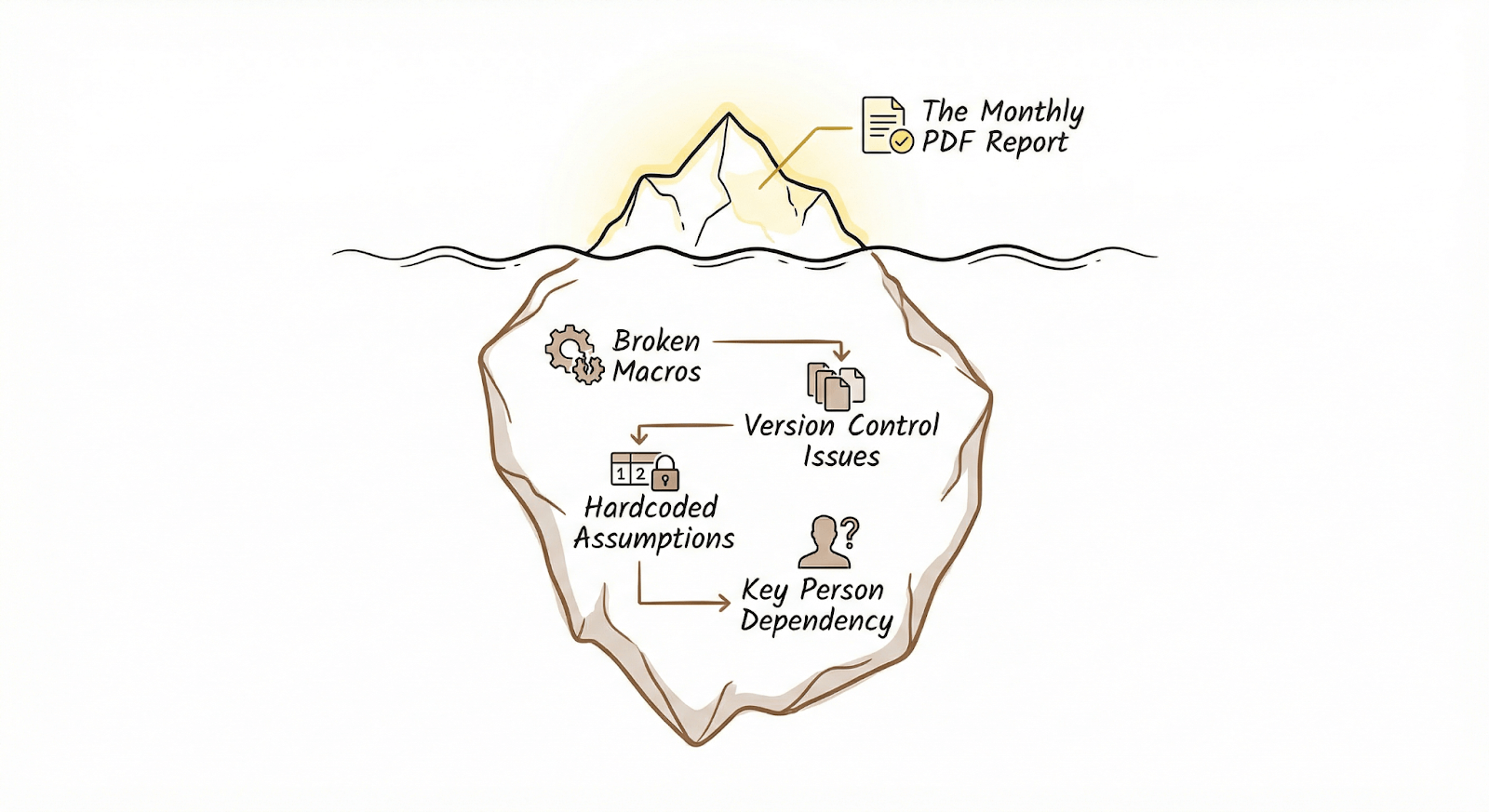
- The "Bus Factor" Risk: Your most critical financial models often live in one person's head (and their local Excel file). If they leave, the logic leaves with them.
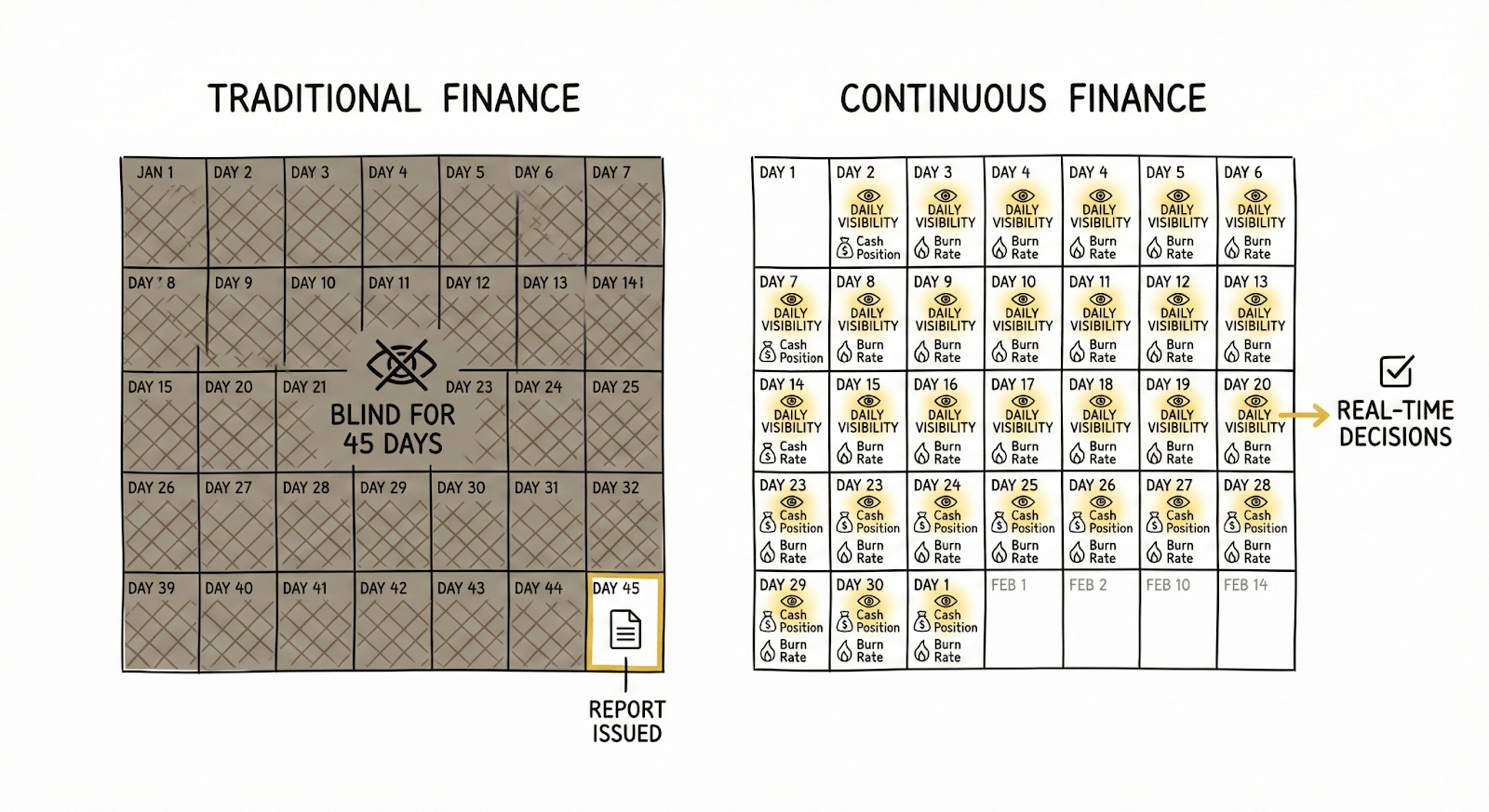
- The Latency Trap: Traditional monthly reporting is a rear-view mirror. By the time you close the books on Day 15, the data is too stale to drive immediate operational decisions.
- Siloed Truths: Your cash reality is fragmented across Bank Feeds, ERPs, and CRMs. Without unification, you never have a single "source of truth."
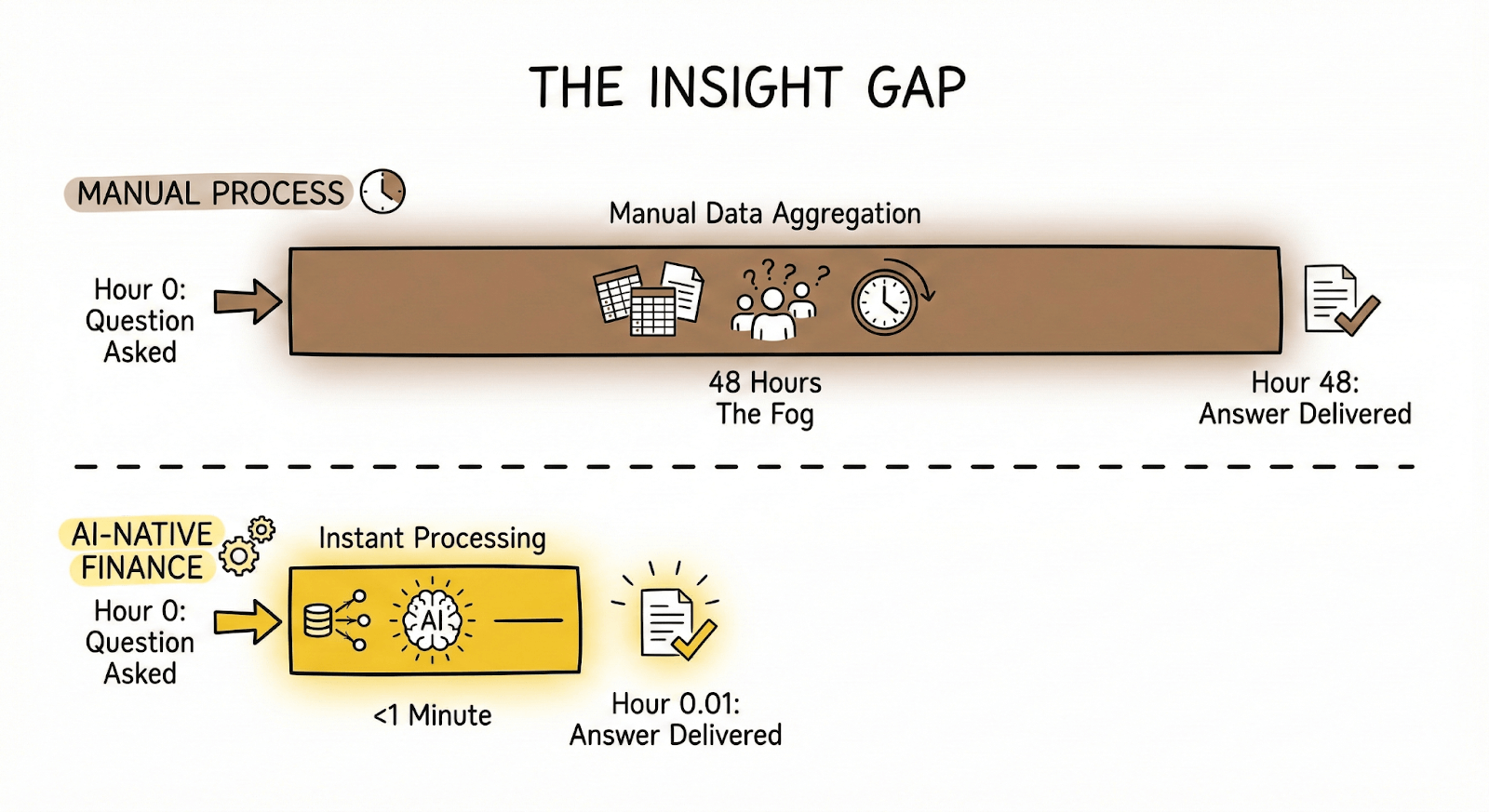
- The Opportunity Cost: While you wait 48 hours for an answer, your competitors are executing.
The Monday Morning War Room
It’s 9:00 AM in Riyadh. You are in the boardroom with the CEO and COO. The quarterly strategy review is tense because the market is moving fast.
Suddenly, the CEO asks a multi-variable question that sounds simple but is actually a mathematical nightmare: > "If we pause the engineering hires in Cairo for three months and shift that 500k SAR budget to paid acquisition in Dubai, exactly how does that impact our cash runway in Q4, and will it trigger a covenant breach?"
The room goes quiet. You know the answer exists. But it is buried. It requires pulling the payroll forecast from HR, the updated ad spend data from Marketing, the current bank balances, and running them through your master Excel model.
You have to say the sentence every CFO hates: "Give me 48 hours to model that."
The alternative is having scenario models that run from live data so the answer exists before the question is asked.
In that 48-hour gap - the "Fog" - opportunities die. The marketing inventory in Dubai might spike in price. The engineers in Cairo might take other offers. You walk out of the meeting feeling less like a Strategic Architect and more like a Data Janitor.
1. The "Black Box" Risk: Fragility at Scale
We need to be honest about Excel. It is the greatest calculator ever invented, but it is a terrible database.
In most companies doing $1M+ in revenue, the master financial model is usually built by one "Excel Wizard." It is a complex web of macros, lookups, and linked sheets. It works until it doesn't.
The answer isn't a better spreadsheet, it's moving the data layer out of Excel entirely so that the logic doesn't walk out the door with one person.
This creates a massive governance risk. If that Finance Manager leaves, or if a link breaks, the "Black Box" stops outputting truth. You are left trying to reverse-engineer hard-coded logic while the board waits for answers. The hidden risk: You aren't building an asset; you are building a dependency on manual maintenance.
2. The "Copy-Paste" Tax: Wasting Expensive Talent
Calculate the hourly rate of your finance team. Now, calculate how many hours they spend exporting CSVs from your ERP, formatting columns, and reconciling bank transactions manually.
This is the "Copy-Paste Tax."
It is not just about money; it is about morale and utility. You hired CPAs and CFAs for their brains, their ability to spot trends, and their strategic foresight. If they are spending the majority of their week data wrangling, you are underutilizing your most expensive assets.
The shift: When you automate the "grunt work" of reconciliation, your team shifts from reporting on the past to predicting the future.
3. The Latency Trap: Driving with the Rear-View Mirror
In a fast-moving market like the GCC, a Monthly Report delivered on the 15th of the following month is effectively a history lesson.
If you burned too much cash in Week 1, finding out about it in Week 6 is useless. You cannot fix the past. Manual spreadsheet reporting forces you to be reactive. You are constantly explaining why a variance happened, rather than spotting the variance in real-time and correcting course before it impacts the P&L.
4. Disconnected Data: The Silo Problem
Finance is the mathematical truth of the business, but that truth is currently fractured.
- The Bank knows what you spent.
- The ERP knows what you booked.
- The CRM knows what you expect to sell.
These systems rarely talk to each other fluently. The CFO’s job becomes the "human API," manually stitching these silos together to create a coherent picture. This manual integration is where errors happen. A missed invoice or a double-counted revenue item in a spreadsheet can swing a forecast by 10% instantly.
The Inevitable Evolution: From Janitor to Architect
The frustration you feel with Excel isn't because you aren't working hard enough. It's because the tool wasn't designed for the speed of modern business.
The industry is moving toward Continuous Finance. This isn't just "faster Excel"; it is a fundamental shift in how data is handled.
- AI Agents as the "Junior Analyst": Imagine software that ingests transactions 24/7, categorizing them and flagging anomalies automatically. This eliminates the "Copy-Paste Tax."
- Democratization of Data: You shouldn't need to be an Excel wizard to understand business health. Modern platforms allow CEOs and COOs to ask questions (like the war room scenario above) and get answers based on live data, not static cells.
- Predictive vs. Retrospective: Instead of telling you "We missed the budget last month," AI-driven tools tell you, "Based on current hiring velocity, you will hit a cash crunch in Week 43."
Kudwa acts as this connective tissue. It integrates with your banks, ERPs, and spreadsheets to create a live, unified data layer. It doesn't replace the CFO; it arms them. It turns the "48-hour delay" into a 48-second answer.
Conclusion: Reclaiming Your Strategic Role
Sticking to manual spreadsheets feels safe because it is familiar. But in a world where speed is the primary competitive advantage, manual finance is a business risk.
The goal isn't to fire the finance team; it's to free them. It's to ensure that the next time the CEO asks a complex strategy question in the Monday meeting, you don't have to ask for 48 hours. You can look at the screen, see the live impact, and make the decision right then and there.
Stop acting as the data janitor. Start being the architect.
Ready to close the gap?
Stop relying on static spreadsheets to run a dynamic business. Book a 15-minute walkthrough
Latest from Kudwa

5 Best AI Finance Tools in the UAE for 2026
Every finance platform now talks about AI. The harder question for UAE finance teams is which tools actually remove work and earn their place in the stack.

Finance Software ROI: How to Judge Your CFO's Next Request
A $30,000 software request looked like overhead. Six months later it cost $200,000 in margin. How to judge finance software ROI before you decline.