How to become an ROI focused CFO or finance leader?
Still reporting last month’s numbers? This blog explores how Kudwa frees finance leaders to drive strategy, not spreadsheets.

How to pivot from historical reporting to predictive value creation in the GCC’s high-growth market.
At-a-Glance: Executive Summary
Bottom Line Up Front: If your primary contribution to the boardroom is an accurate P&L from last month, your role is at risk of automation. The modern CFO is not a gatekeeper; they are the architect of value.
- The "No" Dept: Moving from the "Office of No" to the "Office of How."
- Context Blindness: Why staring at internal spreadsheets causes you to miss external market shifts.
- The HR Friction: How to analyze the ROI of "soft spend" (like company parties) without looking like a miser.
- Scenario Paralysis: The danger of stating facts ("We missed budget") vs. offering solutions ("Here is how we recover").
- Data Jail: You cannot be strategic if 80% of your week is spent cleaning data in Excel.
- GCC Agility: In a region moving away from oil dependence to diversified tech/services, speed of insight beats accuracy of history.
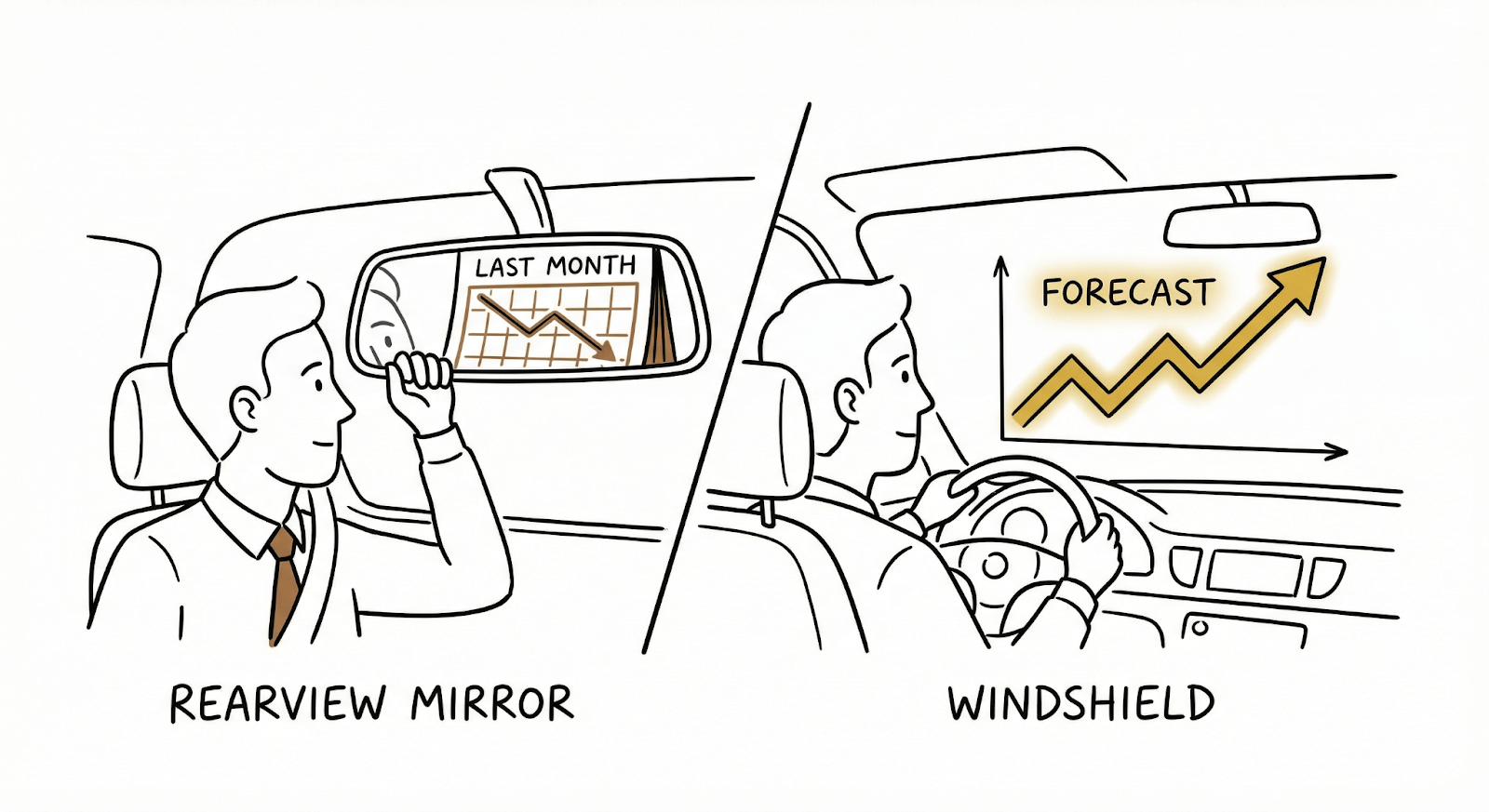
The "Rearview Mirror" Syndrome
Imagine you are driving a high-performance sports car on Sheikh Zayed Road at 120 km/h. But instead of looking through the windshield, you are driving entirely by staring at the rearview mirror. You know exactly where you were ten seconds ago, but you have no idea what is about to hit you.
This is how most Finance functions operate today.
We sit in board meetings and present data that is 15 to 30 days old. We explain what happened. But when the CEO asks, "If we hire three more sales reps in Riyadh today, what happens to our cash runway in Q4?", the room goes silent. The "Old CFO" says, "Let me run the numbers and get back to you next week." By then, the opportunity is cold.
The "New CFO" pulls up a dynamic model and gives an answer in five minutes.That's what driver-based forecasting from live data makes possible. Even better, the “New CFO” already knows what the CEO will ask and is ready with multiple scenarios.
The transition from Operational Operator (keeping the lights on) to Strategic Architect (designing the future) is painful. It involves friction with HR, pressure from competitors, and a fundamental rewiring of how you view money. But in the current economic climate, it is the only way to survive.
4.1 The ROI Obsession: Optimization vs. Amputation
The easiest way to improve net income is to cut costs. It is also the laziest. The "Old CFO" creates value by amputation, slashing marketing budgets or freezing hiring. This boosts the P&L for a quarter but bleeds the company dry of innovation.
The "New CFO" doesn't ask "How much does this cost?" They ask "What is the Return on Investment (ROI)?"
You must analyze the ROI of every spend. This doesn't mean you reject spending; it means you demand accountability for it.
- Marketing: Don't just approve a budget. Demand to see the Customer Acquisition Cost (CAC) relative to Lifetime Value (LTV).
- Tech Stack: Don't just pay for software. Measure the hours saved per employee.
The Shift: You stop being the person who cuts the budget and start being the person who reallocates capital to the highest-performing assets.
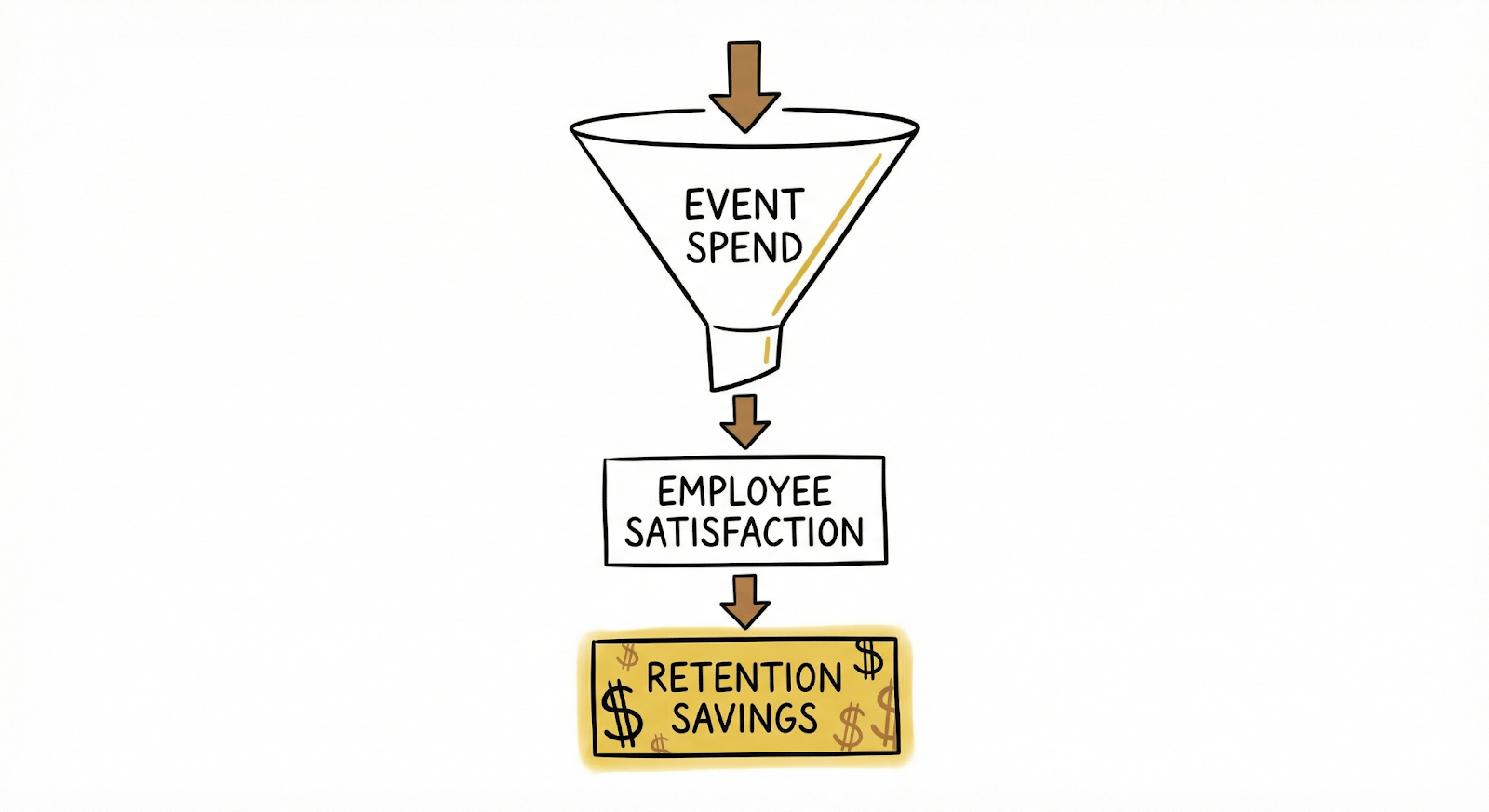
4.2 The "HR Party" Dilemma: Quantifying the Intangible
This is the classic finance manager headache. HR wants $10,000 for a company retreat. The "Old CFO" sees this as a waste of money with zero revenue attribution.
However, rejecting these requests creates a toxic "us vs. them" culture where Finance is the enemy.
How the Strategic CFO handles it: You don't say "No." You ask for the mechanism of return.
- "If we spend $20k on this retreat, we need to see a correlation in our eNPS (Employee Net Promoter Score) or a reduction in our turnover rate."
- The Math: If replacing a mid-level manager costs $15K in recruitment fees and lost productivity, and this retreat prevents one key resignation, the ROI is positive.
By framing it this way, you force HR to think commercially. You become a partner in culture building, not the police officer shutting it down.
4.3 From "Fact Stater" to "Scenario Planner"
Most finance managers are excellent "Fact Staters."
- "Revenue is down 10%."
- "OpEx is over budget."
The CEO doesn't need you to read the news; they can see the variance column themselves. They need you to be the "Scenario Planner."
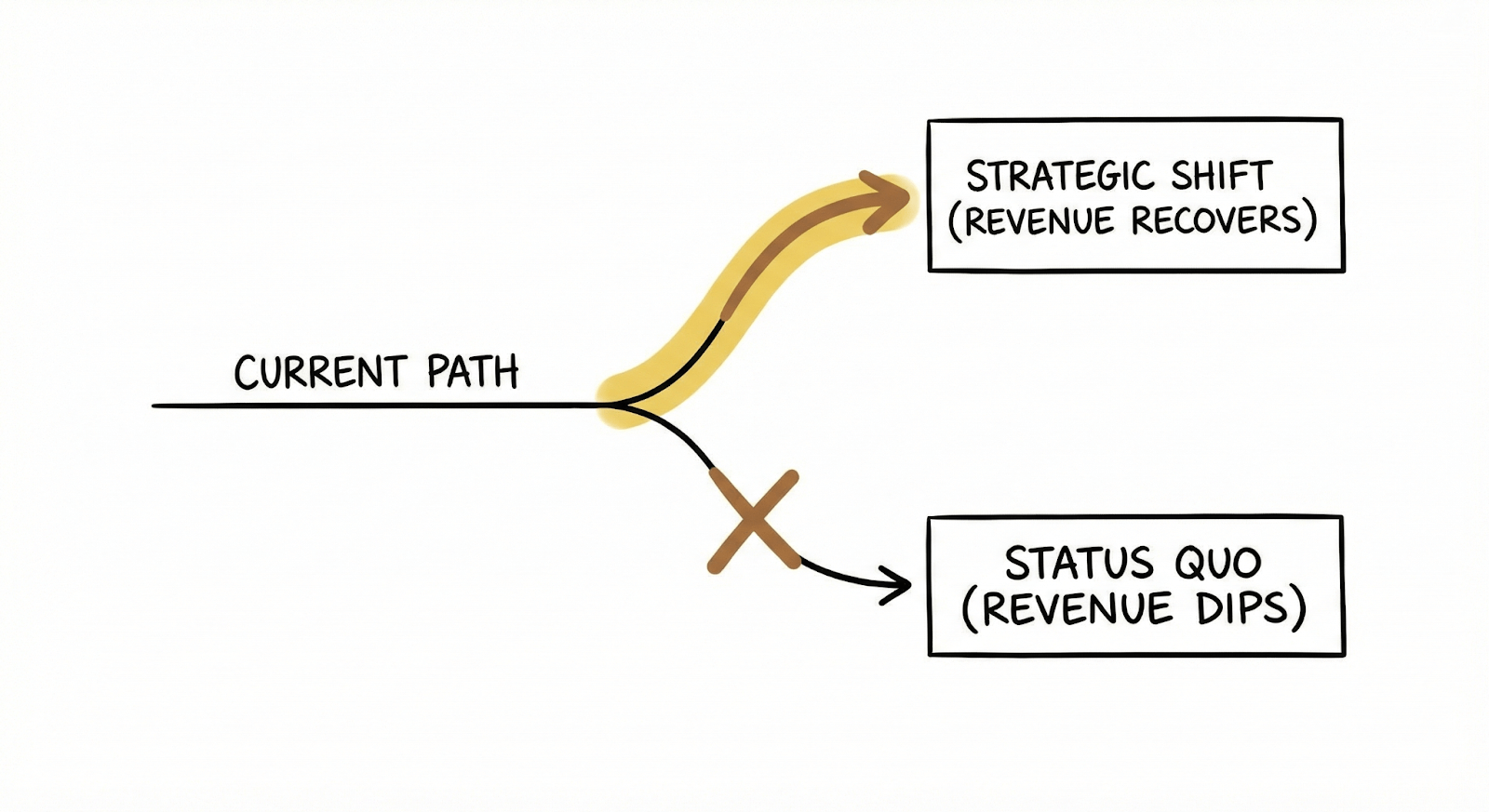
The Strategic Input: Instead of stating the variance, provide the lever to fix it.
- "Revenue is down 10% because the Saudi market adoption is slower than expected. If we shift 15% of our UAE ad spend to Riyadh for the next 2 months, our model suggests we can recover 5% of that gap."
This moves you from a passive reporter to an active combatant in the market war. You are giving the CEO options, not just problems.
4.4 The Unexpected Pressure Cooker: Market & Competitors
You didn't sign up for marketing strategy, yet here you are. As a finance leader in a $1M-$50M revenue company, you are often the only person pragmatic enough to watch the competition.
While Product is obsessing over features and Sales is obsessing over quotas, the CFO must obsess over Unit Economics in relation to the market.
- The Trap: Your margins are healthy today.
- The Reality: A competitor just raised a Series B and is undercutting your price by 20% to grab market share.
If you are only looking at your own historical books, you won't see this coming until your churn rate spikes. A strategic CFO monitors external benchmarks and alerts the C-suite: "Our competitors are burning cash to steal share; we need to decide if we protect margin or protect share. We cannot do both."
4.5 The Tooling Trap: Why Excel is the Enemy of Strategy
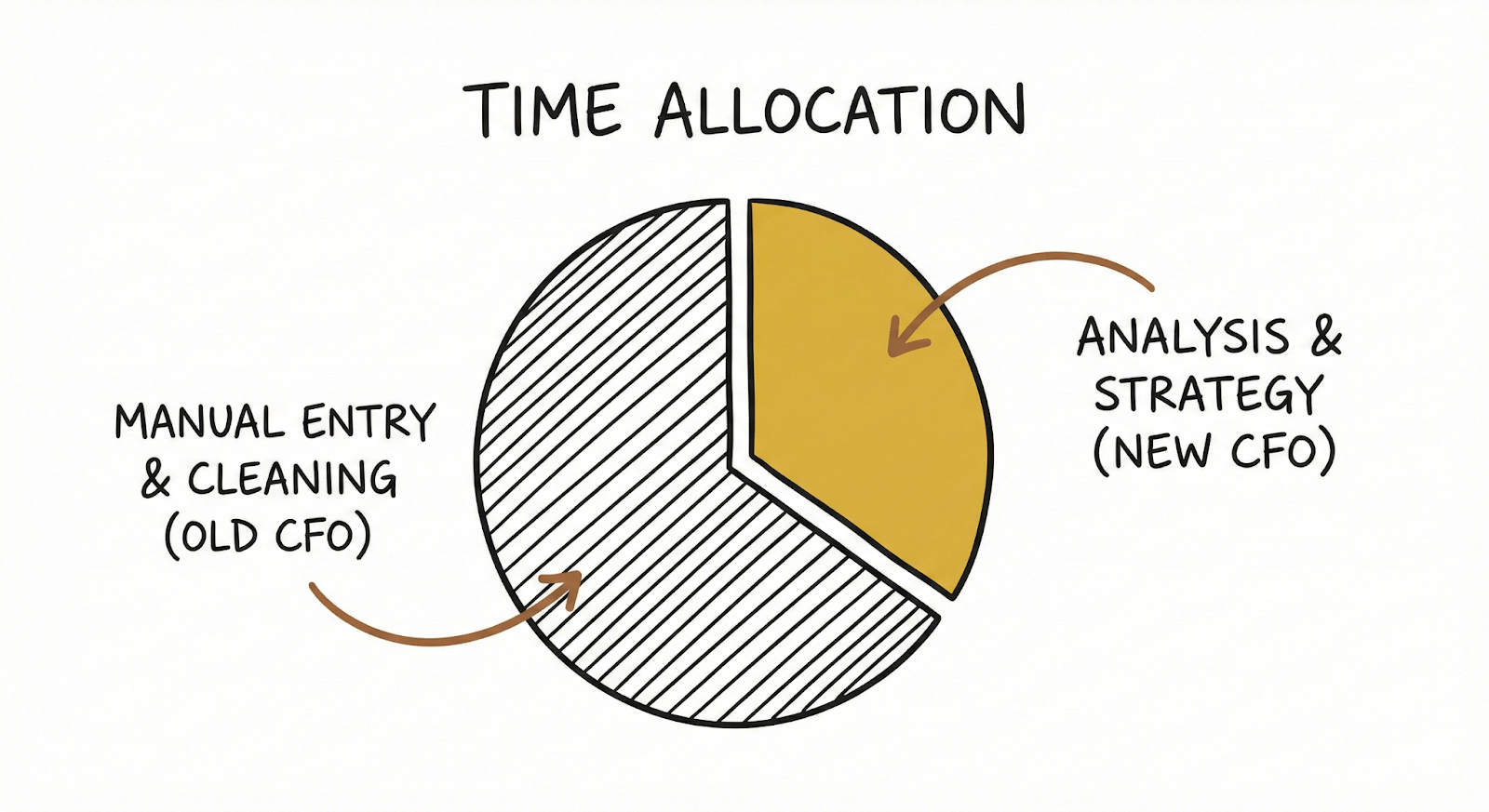
You cannot be an ROI-focused, strategic advisor if you spend the first 10 days of every month manually reconciling bank statements, checking consolidation, manually adjusting all the entries, and chasing every stakeholder to close the books.
The "Time Tax" of Manual Finance:
- Data Cleaning: 60% of time.
- Reporting: 30% of time.
- Analysis/Strategy: 10% of time.
To sit at the strategic table, you must flip this ratio. You need 80% of your time for Analysis and Strategy. This is physically impossible if your financial "truth" lives in 15 disconnected spreadsheets that break every time you add a new row.
The Solution: The Strategic Exo-Skeleton
You don't need to work harder; you are likely already working 60-hour weeks. You need to offload the "Fact Stating" so you can focus on the "Strategy".
This is where Kudwa acts as your enabler.
Kudwa isn't about replacing the finance function; it's about automating the rearview mirror so you can look through the windshield.
- Integrate: Connect your accounting software, banks, and payment gateways into a single source of truth.
- Automate: Let the software handle the reconciliation and the baseline reporting.
- Analyze: Use the time saved to run analytics, scenarios and find answers. What happens if we close Entity A?
When the CEO asks that difficult question, you shouldn't have to say "I'll get back to you." You should be able to pull up the dashboard, toggle a variable, and give an answer.
Conclusion
The era of the "Bean Counter" is over. In the dynamic markets of the GCC and beyond, companies don't need someone who can count the beans; they need someone who knows how to grow them.
You have the skills to be a strategic partner. You understand the numbers better than anyone. The only thing standing in your way is the manual grunt work that keeps your head down.
It’s time to look up.
Ready to stop reporting the past and start modeling the future? Book a 15-minute walkthrough
Latest from Kudwa

5 Best AI Finance Tools in the UAE for 2026
Every finance platform now talks about AI. The harder question for UAE finance teams is which tools actually remove work and earn their place in the stack.

Finance Software ROI: How to Judge Your CFO's Next Request
A $30,000 software request looked like overhead. Six months later it cost $200,000 in margin. How to judge finance software ROI before you decline.