Why Finance Teams Keep Exporting from Their ERP Back Into Spreadsheets
Why do finance teams keep exporting ERP data into spreadsheets? Discover the risks of manual reporting rebuilds and how a post-accounting layer solves them.

How finance teams move from manual reporting rebuilds to a more repeatable system for management reporting, cash visibility, and decision-ready analysis.
At-a-Glance Executive Summary
- ERP limits: Core accounting systems are built to record transactions, not to instantly generate decision-ready narratives.
- Spreadsheet drag: Exporting, mapping, and combining data manually creates an unnecessary bottleneck.
- Manual rebuild: Finance teams are forced to reconstruct the company's financial truth from scratch every single month.
- Version chaos: Connecting multiple offline files breaks the audit trail and causes endless reconciliation loops.
- Hidden logic: Complex chart of accounts mapping and variance calculations often live in a fragile workbook managed by one person.
- Cash gaps: True cash visibility requires blending ERP outputs with bank data—a process that is chronically slow when done offline.
- Key-person risk: When standard reporting relies on a specific individual’s spreadsheet mastery, the entire finance function is vulnerable.
- Missing layer: Most businesses lack a dedicated system that bridges the gap between recorded data and strategic finance analysis.
Picture the modern finance department. Leadership has just invested heavily in a top-tier ERP or advanced cloud accounting system. The promise was unified data, seamless workflows, and instant finance visibility. Yet, at the end of the month, the Group Finance Manager is still doing exactly what they did before: clicking "Export to CSV."
They pull the trial balance, download the operational data, extract the payroll file, and dump it all into a massive Excel workbook. Why? Because the core systems are in place, but the real reporting work—the mapping, the entity consolidation, the variance analysis, the narrative—still happens completely outside of them.
This is a familiar reality for fast-moving businesses, particularly in dynamic markets like the GCC, where cross-entity structures, multi-currency operations, and rapid expansion demand that finance teams move quickly without losing control.
Here is the reality: Spreadsheets are not always the problem. Needing them as the core reporting engine is. Finance teams do not rebuild reports in spreadsheets because they enjoy manual work; they do it because there is a missing link. What these teams actually need is a post-accounting layer—a layer above ERP and accounting systems that turns recorded financial data into decision-ready reporting, consolidated visibility, and stronger finance analysis.
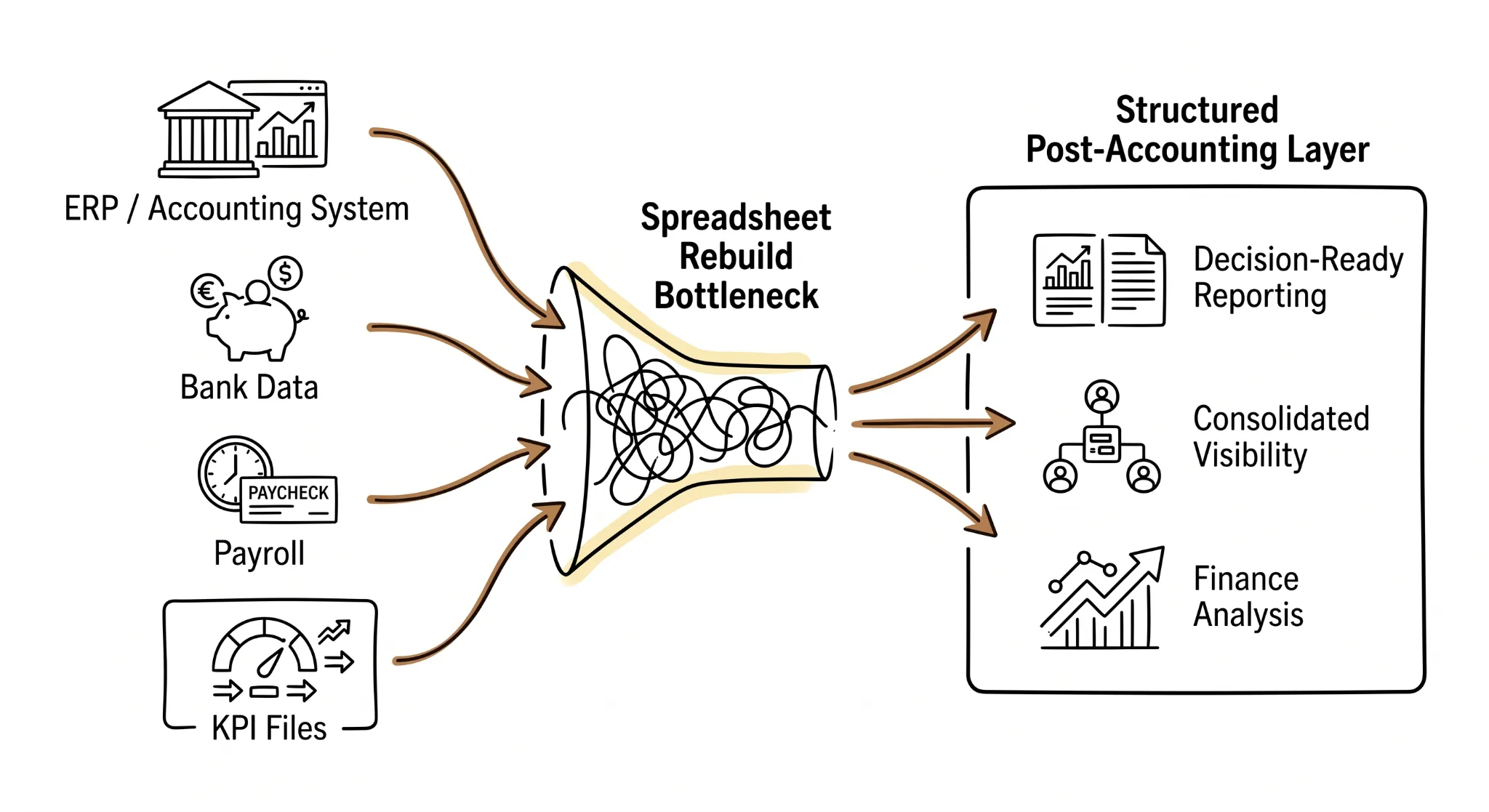
1. Why Finance Still Uses Spreadsheets
To be clear, we are not blindly attacking spreadsheets. Spreadsheet reporting is practically a native language for FP&A modernization and financial analysis.
Spreadsheets are unmatched when it comes to raw flexibility. If a CFO needs to run a quick scenario planning exercise, build a one-off EBITDA forecast for a potential acquisition, or slice data for ad hoc financial analysis, a spreadsheet is the fastest tool for the job. Early-stage businesses rely heavily on them because their operations haven't yet outgrown manual grids. Excel and Google Sheets are powerful sandboxes for business intelligence when used correctly.
2. The Reporting Rebuild Happens Every Month
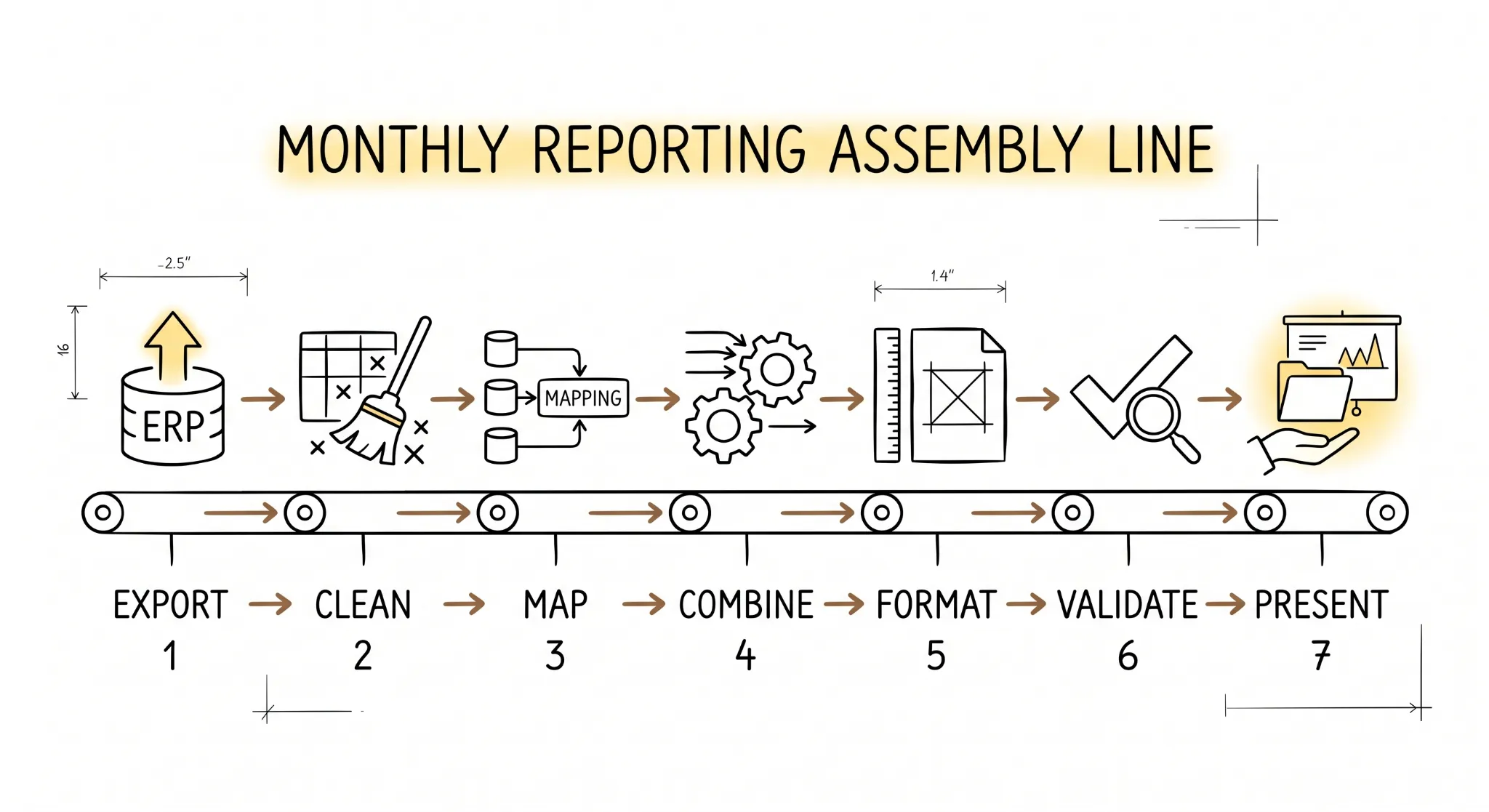
The problem arises when that sandbox becomes an assembly line.
Let's look at the standard finance reporting workflow for monthly reporting. The finance team exports data from the ERP. They manually map new ledger accounts. They merge in payroll data and VAT / tax compliance adjustments. They write VLOOKUPs to bring in CRM metrics. They add side calculations for working capital and run a variance analysis to compare actuals against the budget. Finally, they format the output to make it presentable for a board reporting pack.
This is not lightweight, flexible analysis. This is a heavy, recurring production process. Finance is effectively manually rebuilding the company's financial truth every 30 days outside the system of record.
3. The Difference Between Flexible Analysis and Manual Reporting Dependency
Where does a helpful tool turn into a massive operational risk? It happens the moment your core reporting logic is held hostage by a single file.
Using a spreadsheet to test a new pricing model is healthy. Relying on a 50-tab workbook with fragile macros, hidden tabs, and manual mappings to generate your consolidated reporting is a dependency. When your management reporting is entirely reliant on one person’s ability to remember which cells to update, the risk profile of your operational finance changes dramatically.
4. Why ERP Outputs Still Aren’t Enough for Leadership
If ERP systems are so powerful, why do finance teams keep exporting from them? Because ERP reporting alone rarely answers the questions leadership is actually asking.
ERPs are phenomenal at enforcing structure and recording transactions. But a CEO doesn't just want to see a standard balance sheet. They need context. They want to see entity comparisons, margin interpretation, runway, and an action-oriented narrative. They need a KPI dashboard that connects financial data with operational realities. Because the ERP cannot automatically blend diverse data streams—like API connectors from operational tools or unstructured banking data—finance teams are forced to extract the data and build that narrative themselves.
5. Where Spreadsheet Reporting Starts Breaking Down
As a company scales—adding new business lines, operating across borders, or dealing with multiple currencies—spreadsheet logic starts to buckle under the pressure. The friction points become obvious:
- Version confusion: "Is Final_Board_Pack_v4_FINAL.xlsx actually the latest version?"
- Manual error: A broken formula in row 400 silently skews the entire cash flow forecasting model.
- Broken traceability: Without a clear audit trail, tracking a number back to its source transaction is painfully slow.
- Slow consolidation: Multi-entity reporting becomes a multi-day nightmare of currency translation and intercompany eliminations.
- Delayed answers: When leadership asks a follow-up question, the team has to dive back into the spreadsheets, delaying the close-to-report cycle and leaving executives operating with partial confidence.
6. 5 Signs Your Reporting Process Is Still Spreadsheet-Dependent
How do you know if your finance team has crossed the line from flexible analysis to dangerous dependency? Use this checklist:
- Your monthly reporting pack is assembled manually outside the ERP.
- One or two people understand the spreadsheet logic behind the numbers.
- Cash reporting depends on multiple offline files being stitched together.
- Consolidated reporting requires heavy, line-by-line manual adjustments.
- Leadership questions trigger follow-up analysis after the reporting pack is already sent.
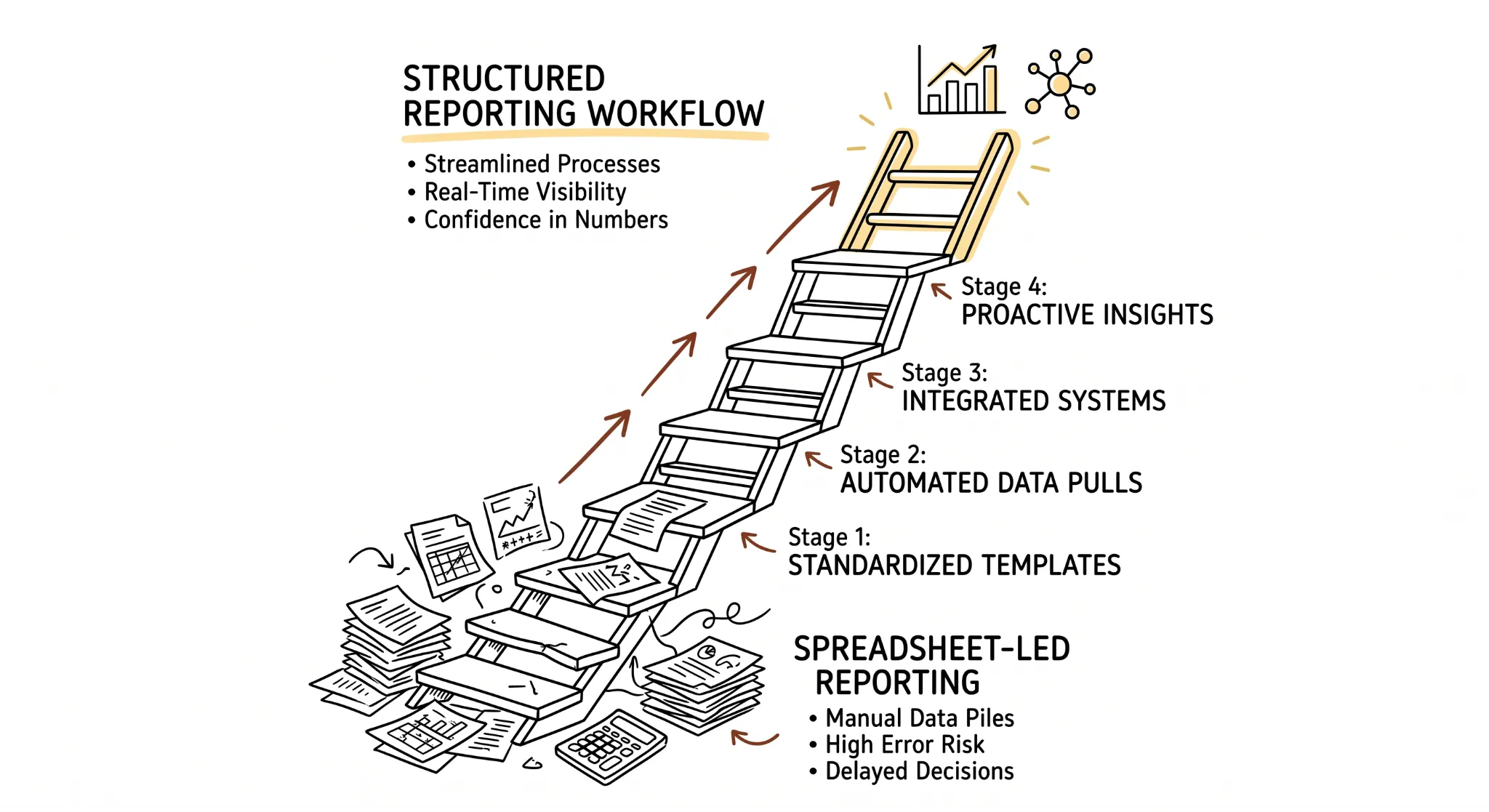
7. What a More Repeatable Reporting Workflow Actually Looks Like
To escape the manual rebuild cycle, finance needs to modernize. A repeatable finance reporting workflow relies on system-connected data flows rather than copy-paste exercises.
It involves standardized chart of accounts mapping across entities, automated management reporting structures, and instant consolidated views. It means cash visibility inputs are pulled directly from banks and accounting systems, and KPI alignment happens automatically. With better traceability and data visualization, finance teams can provide faster answerability for leadership without sacrificing accuracy.
The Solution
For many teams, this is the point where spreadsheets stop being a tool and start becoming a bottleneck. The goal is not to eliminate flexible analysis. It is to remove spreadsheet dependency from recurring reporting.
This is where finance teams often add a post-accounting layer to make reporting more repeatable and less fragile. Kudwa sits on top of your existing finance stack—connecting your ERP, cloud accounting, banking, payroll, and operational systems.
Rather than replacing your ERP or forcing you to abandon Excel for ad hoc work, Kudwa acts as the structured reporting layer. It turns fragmented data into clearer management reporting, consolidated visibility, and better cash insight. By automating the extraction, mapping, and presentation of your data, Kudwa significantly reduces manual rebuild work, allowing your finance team to focus on AI in finance, AI-native FP&A, and driving real strategic value.
Conclusion
Finance teams keep exporting ERP data into spreadsheets because the reporting layer is often missing, not because finance is undisciplined. Spreadsheets will always have a place in finance, but as reporting complexity grows, relying on them as your primary reporting engine becomes a liability that costs you time, accuracy, and strategic agility.
Find out how Kudwa fits on top of your existing finance stack.
Latest from Kudwa

How to Cut Costs Without Hurting Growth
Cutting the spend you can see is easy. Here is how to cut costs without hurting growth: find which dollars produce revenue before you remove them.

AI in FP&A: Which Parts of the Cycle It Can Actually Run
AI in FP&A can name the driver behind a margin miss before your team opens the file. What it runs today, and where approval still sits.