Why Zoho Books Alone Stops Being Enough for Growing Finance Teams
Clean books don't equal clear visibility. Learn why growing finance teams outgrow Zoho Books reporting and need a post-accounting platform for consolidation.

At-a-Glance Executive Summary
- Clean books: Accurate ledgers in Zoho Books do not automatically yield decision-ready dashboards.
- Reporting gap: Harder executive questions quickly expose the limits of native accounting reports.
- Manual rebuild: Exporting data monthly to shape the management pack is an unsustainable finance reporting workflow.
- Entity sprawl: Multiple legal structures in fast-paced markets create severe friction for consolidated reporting.
- Cash blind spots: Genuine cash visibility is fractured across bank portals, operational systems, and accounting records.
- Spreadsheet drag: Manual data wrangling in Excel reporting burns critical hours that lean finance teams cannot afford to lose.
- Leadership lag: Delayed financial analysis forces the executive team to operate with false confidence.
- Missing layer: A modern post-accounting platform bridges the gap between raw transactions and strategic FP&A modernization.
Imagine this: Your company is scaling fast across the GCC. You’ve set up multiple entities to capture new market opportunities. The core finance team runs a tight ship; the ledgers are balanced, the reconciliations are done, and your VAT / tax compliance is firmly under control. You are using a capable cloud accounting system, and from an operational standpoint, everything is working.
But then the end-of-month board meeting approaches.
The CEO wants to see consolidated group performance. The COO needs to understand which specific business unit is dragging EBITDA. The board expects a rolling cash flow forecast that factors in obligations across three different banks and two different currencies.
Suddenly, your clean books aren't enough. The finance team is scrambling, exporting data from Zoho Books into massive spreadsheets, combining it with payroll files, pulling in API data from operational tools, and manually formatting a monthly pack. Reporting has become a recurring, stressful project instead of a reliable system output.
This happens because of one fundamental misunderstanding in modern finance: Accurate accounting is necessary. Decision-ready reporting is a separate capability.
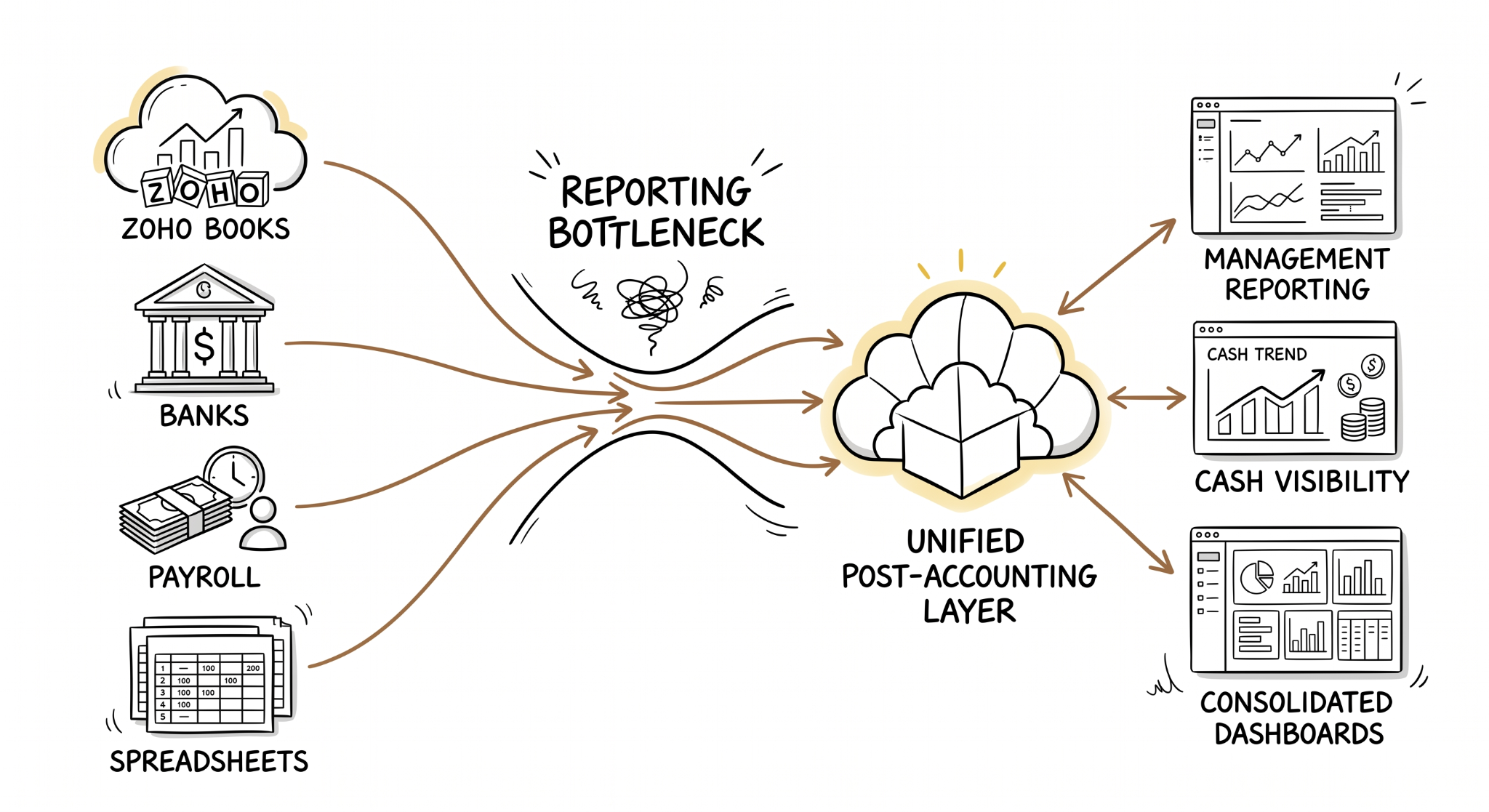
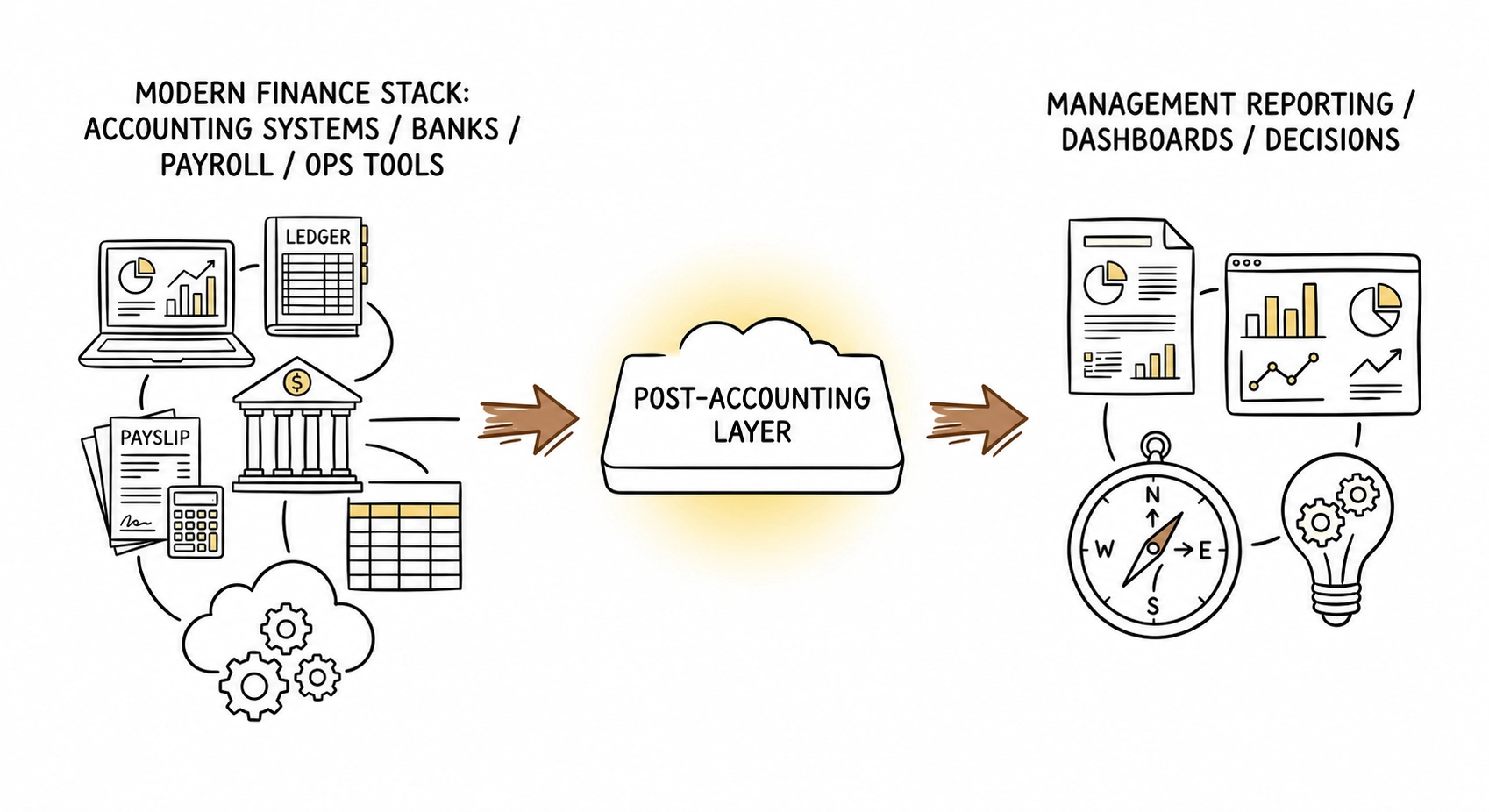
To bridge this gap, growing businesses need a post-accounting layer: A layer above the accounting system that turns clean books into decision-ready reporting, consolidated visibility, and stronger finance analysis.
1. Where Zoho Books Is Strong: The Accounting Foundation
Let’s be clear: the problem is not that Zoho Books is broken. In fact, it is an exceptionally strong tool for what it was built to do.
For many businesses, Zoho Books provides a rock-solid foundation for operational finance. It excels at core bookkeeping, invoicing, expense tracking, and capturing daily transactions. Early on, it gives businesses exactly what they need to manage their financials and maintain basic compliance. The issue is not poor software selection; the issue is asking accounting software to perform a broader, more complex business intelligence and reporting job than it was designed for.
2. The Reporting Gap Appears When Leadership Asks Harder Questions
The pain doesn't start with a broken ledger; it starts with better questions. As your business scales—particularly in highly competitive markets—the demands on the finance team shift from historical record-keeping to forward-looking strategy.
The reporting gap becomes obvious when leadership asks:
- What does our group performance look like this quarter?
- What exactly changed our cash position across all entities?
- Which specific business unit or region is dragging our margins down?
- What narrative and metrics do we show the board this month?
- Why did our performance move compared to our scenario planning?
Native Zoho Books reporting can tell you what was billed and what was paid. But answering these strategic questions requires deeper data visualization, blending financial data with operational metrics. This is exactly where the manual work starts multiplying.
3. Why Reporting Gets Rebuilt Outside the Accounting System
When native ERP reporting or accounting dashboards fall short, finance teams default to the tool they know best: Excel.
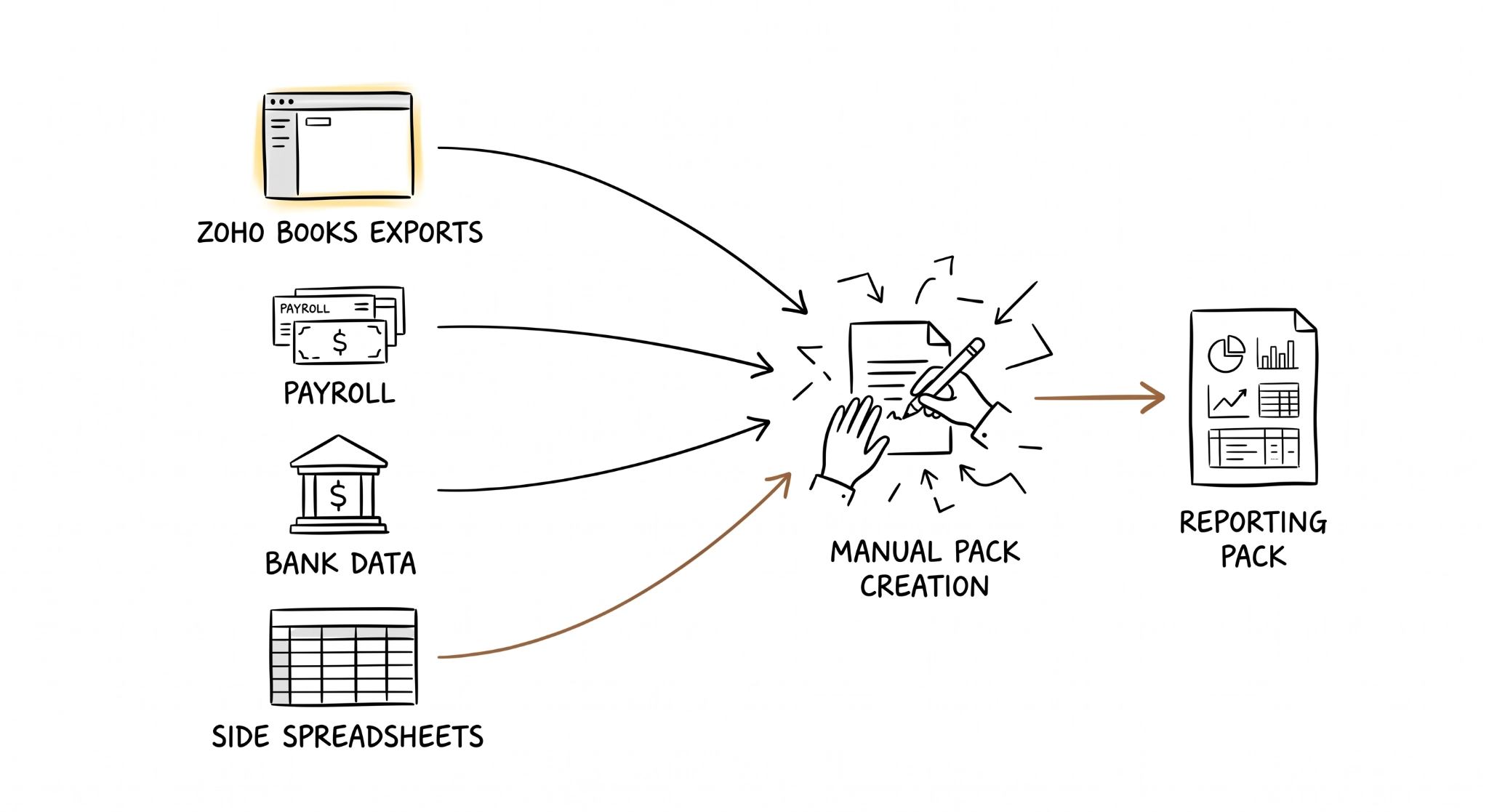
We call this the export-to-Excel pattern. Every month, highly paid finance professionals export trial balances and profit and loss statements from Zoho Books. They dump this into spreadsheets, manually map accounts, paste in payroll data, inject operational metrics, and make late adjustments to force the numbers into a coherent board reporting format.
This manual rebuild means that your management reporting is essentially reconstructed from scratch every 30 days. Different teams end up operating on different realities. Sales has one pipeline number, operations has another, and finance spends weeks reconciling contradictions rather than advising leadership. Reporting is rebuilt because the actual reporting layer is missing.
4. Multi-Entity Growth Makes the Gap Much Worse
Once a company expands into multiple entities, business lines, or joint ventures, finance complexity outgrows accounting-only workflows exponentially.
Multi-entity reporting introduces a web of friction: mapping inconsistent charts of accounts, managing tricky intercompany transactions, handling eliminations, and executing complex roll-ups. Zoho Books consolidation can handle basic requirements, but when you need dynamic group reporting that allows executives to slice data by entity, region, or product line, the accounting system alone struggles to deliver elegantly.
The reality for growing GCC businesses is that cross-entity complexity rises much faster than headcount. Lean finance teams absorb this coordination tax, turning what should be a seamless automated financial reporting process into days of stressful data crunching.
5. Cash Visibility Breaks Long Before Finance Admits It
Cash is the lifeblood of any growing business, but cash visibility is rarely just a bank balance. It requires understanding timing, vendor obligations, collection probabilities, and entity-level capital movement.
In a scaling business, cash insight usually breaks outside the accounting system. True cash visibility is spread across multiple bank portals, operational systems, and disconnected spreadsheets. If you are relying purely on an accounting ledger, you are looking in the rearview mirror. Leadership needs short-term forecasting and runway analysis to make confident capital allocation decisions—something that cannot be generated reliably if the data is fragmented.
6. 5 Signs You’ve Outgrown Accounting-Only Reporting
How do you know when it’s time to modernize? Here are the most common signals that your team has hit the ceiling of accounting-only reporting:
- You still export every month to rebuild management reports: Your month-end close is followed by days of spreadsheet formatting.
- Consolidated reporting depends on one finance team member: If your group consolidation process lives entirely in one person's head (and their complex Excel macros), you have a massive key-person risk.
- Board and leadership questions require follow-up analysis after the meeting: You can't drill down into a KPI dashboard live during a meeting; you have to say, "I'll get back to you with those numbers."
- Cash reporting is spread across multiple tools: You log into three different banks and cross-reference a spreadsheet to understand your cash flow forecasting.
- Finance spends too much time validating, too little time advising: Your highly skilled finance professionals are acting as data janitors instead of strategic partners.
7. The Minimum Reporting Layer a Growing Finance Team Actually Needs
Better accounting discipline is always necessary, but software alone doesn't solve every problem. Excel will always have a place for ad-hoc analysis, and BI tools can help with generic data visualization. However, to truly scale, businesses need a dedicated post-accounting reporting layer.
This layer should provide:
- Consolidated reporting: Automated roll-ups with painless intercompany eliminations.
- Management reporting: Clean, repeatable monthly reporting packs that require zero manual formatting.
- Entity-level and group-level views: The ability to seamlessly toggle between the macro group view and the micro business-unit level.
- Finance-native logic: Built-in intelligence that understands finance reporting workflows, charts of accounts, and financial metrics.
- KPI and operational data alignment: A single source of truth where financial data meets operational realities.
- Cash visibility and forecasting inputs: Dynamic tracking of cash movements and future obligations.
- Auditability and consistency: A clear audit trail that executives and external auditors can trust.
The Solution
The goal is not to replace the accounting foundation. Zoho Books is doing exactly what it was designed to do. The goal is to make the data above it more decision-ready.
For many teams, this is the point where a post-accounting layer becomes necessary. Kudwa is built to sit directly on top of systems like Zoho Books, acting as the bridge between your raw ledgers and executive strategy. It turns fragmented accounting and operational data into automated financial reporting, consolidated visibility, and deeper finance analysis.
This is where finance teams often move from spreadsheet-heavy reporting to a more structured, confident reporting system—giving leadership the exact insights they need, precisely when they need them.
Conclusion
At a certain stage of growth, clean books simply do not equal clear visibility. Zoho Books can help you run your accounting operations flawlessly, but as your business complexity multiplies, your lean finance team will inevitably need a separate reporting layer. Relying on manual spreadsheet rebuilds drains your team's time and forces leadership to make high-stakes decisions based on fragmented, delayed information.
Ready to move beyond manual spreadsheets?
See how Kudwa works on top of your finance stack.
Latest from Kudwa

5 Best AI Finance Tools in the UAE for 2026
Every finance platform now talks about AI. The harder question for UAE finance teams is which tools actually remove work and earn their place in the stack.

Finance Software ROI: How to Judge Your CFO's Next Request
A $30,000 software request looked like overhead. Six months later it cost $200,000 in margin. How to judge finance software ROI before you decline.