How Lean Finance Teams Can Run Serious Reporting Without Adding Headcount
Discover how growing businesses help lean finance teams run management reporting and cash visibility without adding headcount. Reduce reporting drag today.

At-a-Glance Executive Summary
- Lean teams: Capable, but stretched dangerously thin.
- Hidden drag: Over-manual, fragmented finance operations.
- Manual stitching: Exporting and combining data across systems.
- Reporting strain: Growth and complexity outpacing finance capacity.
- Key-person risk: Crucial reporting logic trapped in one person’s head.
- Cash blind spots: Visibility that arrives too late to drive strategy.
- Slow answers: Reactive reporting rather than proactive guidance.
- Missing layer: The absence of a structured reporting architecture.
You probably know a Head of Finance at a rapidly growing GCC enterprise. Operations have expanded across borders, new entities have been established to handle distinct product lines, and the transaction volume has surged. The team is small, tight-knit, and exceptionally capable.
Every month, they successfully close the books. They handle cloud accounting, payroll, and VAT / tax compliance with rigorous discipline. But the moment the close is finished, the real struggle begins.
The finance team transforms into data mechanics. They export CSVs from multiple ERPs, pull bank statements, wrestle with the CRM, and attempt to reconcile it all in a massive, fragile spreadsheet. They are asked to produce executive-grade management reporting, answer urgent board questions, and forecast runway, all while managing a dozen different APIs and connectors. The team isn't failing because they lack financial acumen; they are failing because they are operating in an overloaded model.
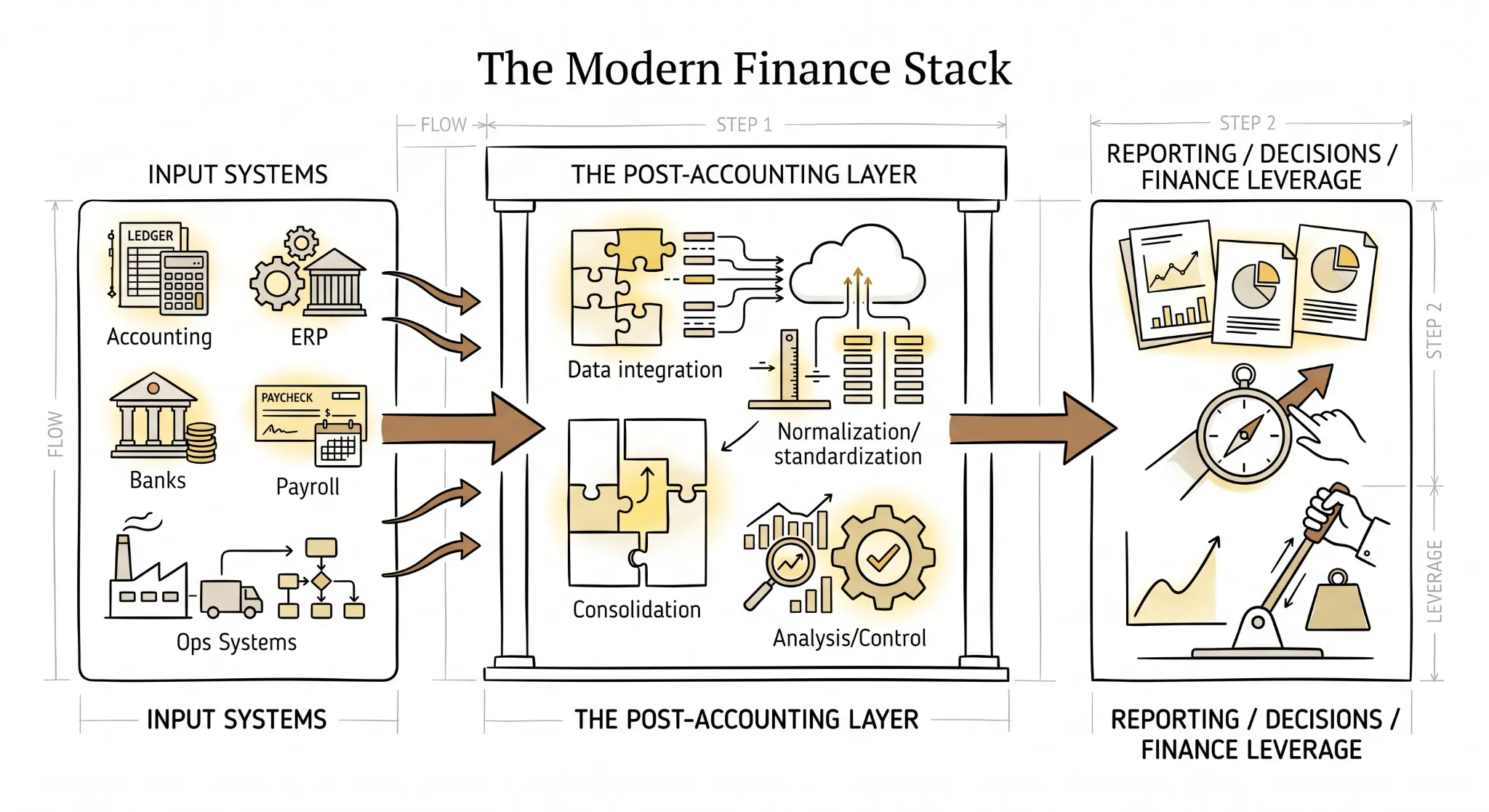
Let's be clear early on: A lean finance team is not the problem. A lean team carrying an over-manual reporting process is. When growth accelerates, finance needs structure. It requires a post-accounting layer: a layer above accounting, ERP, banking, payroll, and operational systems that turns fragmented finance data into decision-ready reporting, consolidated visibility, and stronger analysis.
Why Lean Finance Teams Break First at the Reporting Layer
Growing businesses are under immense pressure to control their OPEX, which often means keeping finance headcount lean even as operational complexity multiplies. In regions like the GCC, cross-entity operations and rapid geographical scaling introduce fragmented systems and multiple currencies almost overnight.
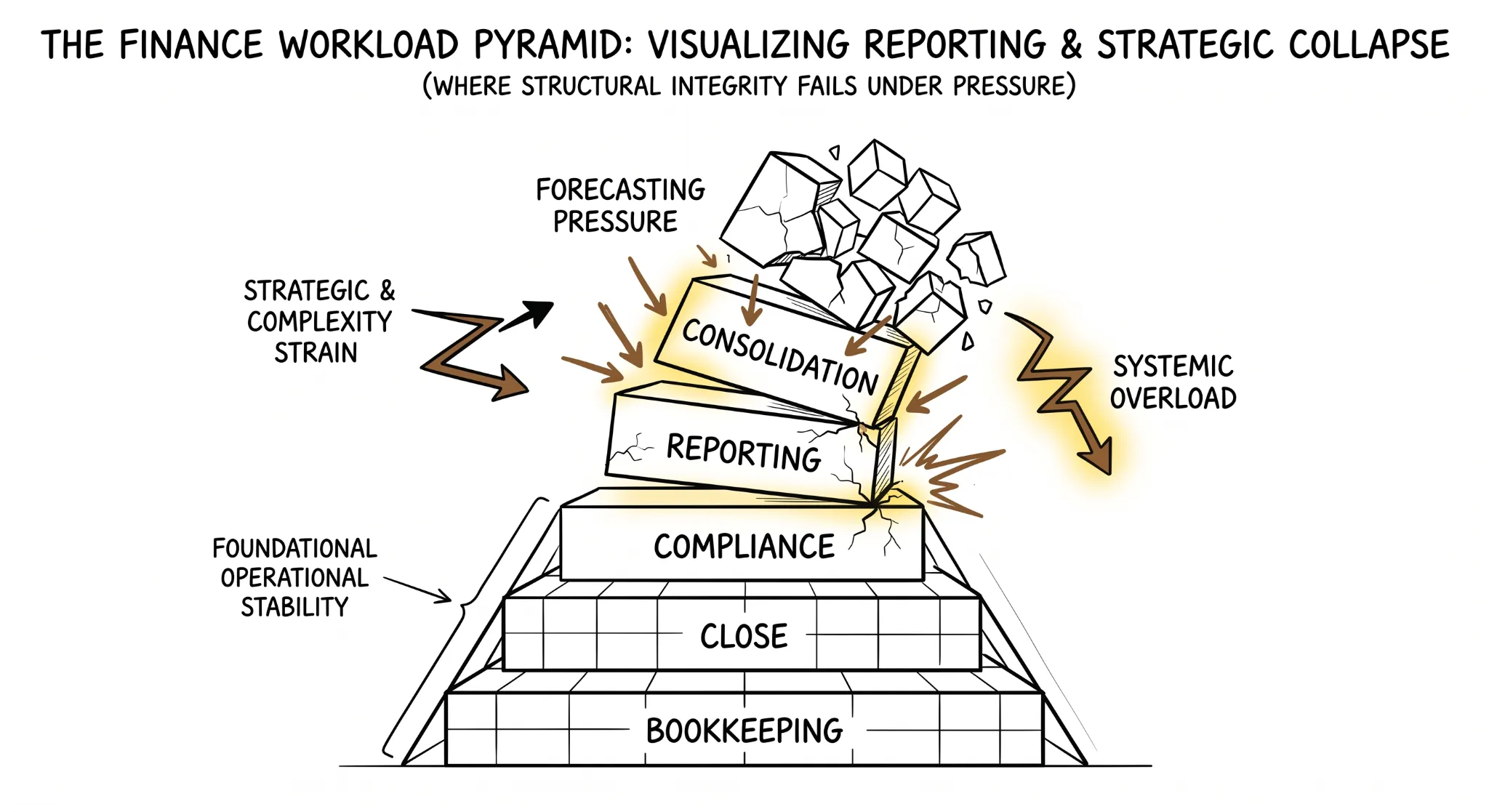
In this environment, accounting still gets done. Invoices are paid, and compliance is met. But the reporting layer cracks. When finance complexity grows faster than finance capacity, reporting slows down, cash visibility weakens, and leadership starts making decisions with less confidence than they think. Multi-entity reporting and monthly reporting become grueling exercises in manual consolidation. The team simply lacks the bandwidth to engage in proactive planning or FP&A modernization.
Where Strong Teams Lose Time Instead of Creating Insight
Sophisticated financial analysis requires time, but that time is routinely cannibalized by coordination overhead. Capable finance professionals lose hours collecting files, validating numbers, aligning versions, and fixing broken spreadsheet mappings.
Instead of acting as strategic advisors conducting scenario planning, finance becomes the manual connector between systems. They are stitching together raw data to build a KPI dashboard instead of interpreting the dashboard to guide the COO. The bottleneck is not intelligence; it is the sheer volume of manual finance reporting workflow. When the monthly reporting turns into a recurring fire drill, the team closes the books only to start a second, exhausting cycle of rebuilding management reports and chasing explanations.
What Serious Reporting Actually Requires
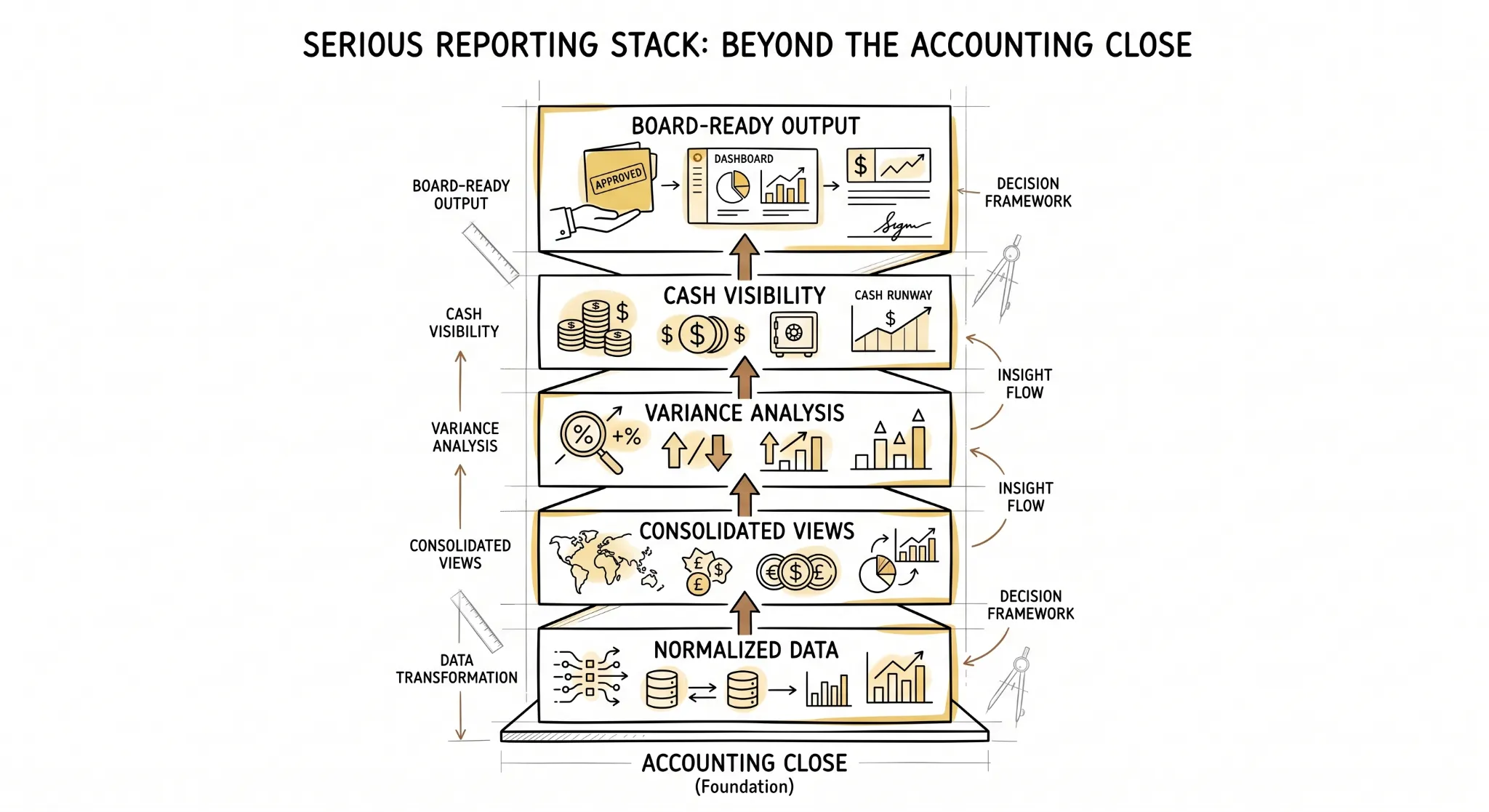
Many scaling companies operate under the illusion that an ERP upgrade or a P&L export equals reporting. But once a company grows beyond a certain threshold, serious reporting requires an entirely different architecture.
It requires:
- Management reporting tailored to executive needs
- Consolidated reporting across all entities
- Strict KPI alignment with operational goals
- Deep variance analysis to explain performance deviations
- Real-time cash visibility and cash flow forecasting
- Predictable, repeatable board reporting
- Fast answerability for leadership inquiries
This is a much heavier operational requirement than simply having clean books. It demands robust business intelligence, data visualization, and an architecture capable of handling multi-entity consolidation without manual intervention.
Where Lean Teams Start Feeling the Strain Most
Even the sharpest operational finance teams will eventually hit a wall if their infrastructure is weak. The strain typically manifests in highly specific, high-friction areas.
These pressure points include:
- Multi-entity consolidation: Dealing with different chart of accounts and currencies.
- Cash reporting: Struggling to unify bank balances and predict runway.
- Board pack prep: Losing days to formatting and narrative construction.
- Intercompany adjustments: Reconciling messy cross-charges manually.
- Side spreadsheets: Spawning uncontrolled, shadow financial reports.
- Key-person dependencies: One person owning the consolidation logic, creating massive fragility.
This is where strong teams start looking slow, even when the problem is purely structural.
Why Adding Headcount is Not Always the First Fix
It is tempting to solve reporting pain by hiring another analyst. And to be honest, sometimes a hire is necessary. Software alone does not solve weak finance operations; better close discipline, cleaner processes, clearer ownership, and stronger accounting hygiene all matter.
However, adding headcount into a broken reporting workflow is not a real fix. If your reporting is fragmented, manual, and repetitive, a new hire will simply absorb the pain without removing the cause. You will increase capacity slightly, but you will not improve the speed or accuracy of your analytics. Hiring alone does not fix bad reporting design.
5 Signs Your Finance Team Is Lean — But Your Reporting Model Isn’t
Before opening a new headcount requisition, assess your current operations. Here is a practical checklist to determine if reporting strain is a headcount problem or a missing-layer problem:
- Monthly reporting depends on manual spreadsheet assembly: Your team is downloading, copying, and pasting to create the primary executive view.
- Consolidated views take too long to produce: Getting a single, accurate view of EBITDA across entities takes weeks, not days.
- Cash visibility requires pulling from multiple places: Understanding your cash position means logging into different bank portals and cross-referencing with the ERP.
- Leadership questions trigger reactive follow-up work: When the CEO asks a simple question about OPEX variance, it takes three days to rebuild the model to find the answer.
- Finance spends more time validating numbers than interpreting them: The team is exhausted by data cleansing and lacks the energy for actual FP&A.
What Gives Lean Finance Teams Leverage
To operate above their size, small finance teams need leverage. Leverage doesn't come from working longer hours; it comes from systemizing the routine.
This requires connected finance data, standardized mappings across entities, and repeatable reporting workflows. By implementing a strong cash reporting structure and reducing manual handoffs, finance creates clearer narrative support and stronger answerability. Advancements like AI in finance, AI-native FP&A, and agentic AI are only effective if they sit on top of normalized, clean data. Ultimately, teams need financial reporting automation that reduces the coordination tax.
The Solution: Scaling Insight, Not Just Headcount
For many businesses, this is the point where the finance team does not need more dashboards. It needs more reporting leverage.
The goal is not to avoid hiring forever. It is to stop spending headcount on manual reporting rebuilds. This is where a post-accounting layer can help a lean finance team function more like a larger one.
By utilizing a platform like Kudwa, growing businesses can introduce a structured layer that sits directly on top of existing accounting and operational systems. Kudwa is designed to reduce manual reporting work, improve consolidated visibility, and strengthen cash understanding. It doesn't replace the need for brilliant finance minds; it liberates them, allowing them to move faster from raw numbers to commercially useful insight.
Conclusion & Next Steps
A lean finance team can absolutely run serious, executive-grade reporting, but not if it is stuck acting as the manual bridge between every system, spreadsheet, and last-minute executive request. As business complexity grows, your reporting model must mature alongside it. Upgrading your finance reporting workflow is the only sustainable way to protect your team and ensure leadership has the visibility required to guide the business.
See how Kudwa helps lean finance teams get more leverage from their existing stack.
Book a quick call and see how Kudwa is the right solution for your finance team.
Latest from Kudwa

5 Best AI Finance Tools in the UAE for 2026
Every finance platform now talks about AI. The harder question for UAE finance teams is which tools actually remove work and earn their place in the stack.

Finance Software ROI: How to Judge Your CFO's Next Request
A $30,000 software request looked like overhead. Six months later it cost $200,000 in margin. How to judge finance software ROI before you decline.