Why SAP Business One Still Leaves Finance Teams Rebuilding Reports in Excel
Discover why SAP Business One still leaves finance teams in Excel. Learn how a post-accounting layer automates management reporting and improves cash visibility

At-a-Glance Executive Summary
- ERP control: SAP Business One provides essential operational structure and accounting discipline.
- Reporting drag: Getting decision-ready data out of the system remains highly manual and time-consuming.
- Excel rebuild: Finance teams still export trial balances to construct their monthly reporting outside the ERP.
- Standard limits: ERP outputs track transactions; leadership needs strategic narrative and variance analysis.
- Entity complexity: Multi-entity roll-ups and intercompany eliminations quickly break standard reporting capabilities.
- Cash blind spots: True cash flow forecasting requires data that lives across bank portals, payables, and the ERP.
- Narrative gap: Reconciling data contradictions leaves little time for FP&A modernization.
- Missing layer: A post-accounting layer bridges the gap between raw ERP data and executive insights.
The Familiar Monthly Reporting Scramble
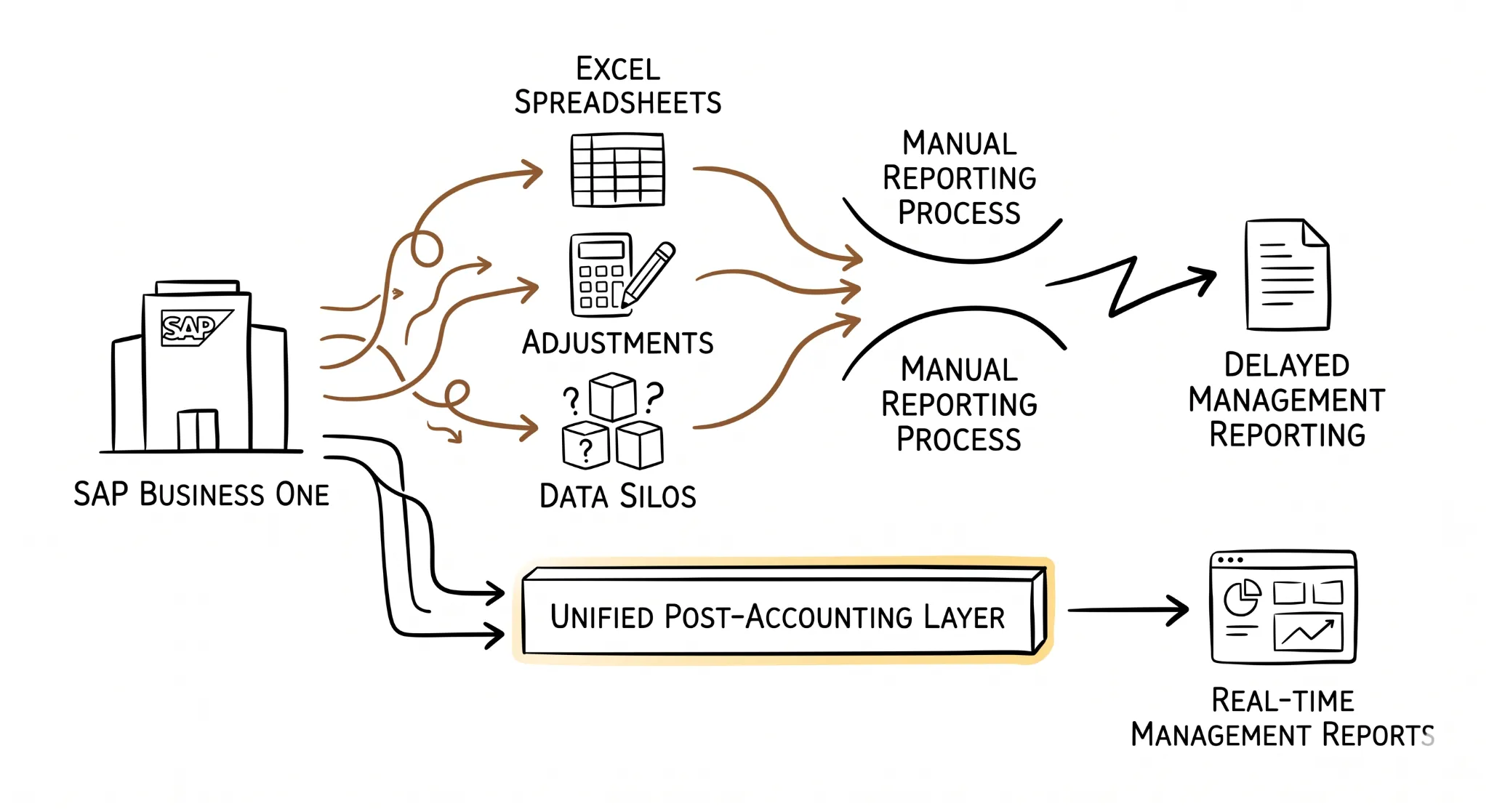
You invest in an ERP to create structure. You implement SAP Business One to standardize processes, centralize operational records, and bring order to complex workflows. The implementation goes live, the data is flowing, and operational finance is finally under control.
Yet, when month-end arrives, the reality sets in: the finance team is still exporting data into Excel to build the reports leadership actually needs.
This is a common reality, particularly in fast-growing markets like the GCC, where the pace of growth, legal structure complexity, and operational sprawl outpace standard system outputs. The pressure on lean finance teams to deliver executive-grade clarity across multiple entities and business units is immense.
To solve this, we must define the missing piece of the puzzle: the post-accounting layer. Simply put, it is a layer above the ERP and accounting system that turns recorded transactions into decision-ready reporting, consolidated visibility, and stronger finance analysis.
The core truth that many businesses learn the hard way is this: ERP structure improves control, but control is not the same thing as reporting clarity.
Where SAP Business One Is Strong
To be clear, the issue is not that SAP Business One has failed. In fact, it is exceptionally good at doing an ERP's job.
SAP Business One is a powerhouse for operational discipline. It centralizes transaction capture, standardizes procurement and billing, enforces accounting structure, and ensures process control. Whether you are managing complex inventory, handling VAT / tax compliance, or processing payroll across different departments, the ERP establishes a single source of truth for your foundational data. Cloud accounting and robust API connections ensure data is captured accurately.
The problem is not a lack of data; it is the gap between recorded, structured data and decision-ready finance visibility.
Why Finance Still Ends Up in Excel
If the ERP holds all the data, why does Excel become the unofficial reporting layer?
Because standard SAP Business One reporting outputs do not match how your specific leadership team thinks. Every month, finance teams export trial balances and transaction lists into massive spreadsheets. They perform pivots, execute manual chart of accounts mapping, build side calculations for EBITDA or OPEX runways, and overlay custom KPI dashboards.
This Excel reporting rebuild happens because standard ERPs are built to balance the books, not to explain the business. The exports, manual adjustments, and reporting templates outside the ERP become the real monthly workflow, resulting in severe reporting fatigue and delayed decisions.
The Difference Between ERP Reports and Management Reporting
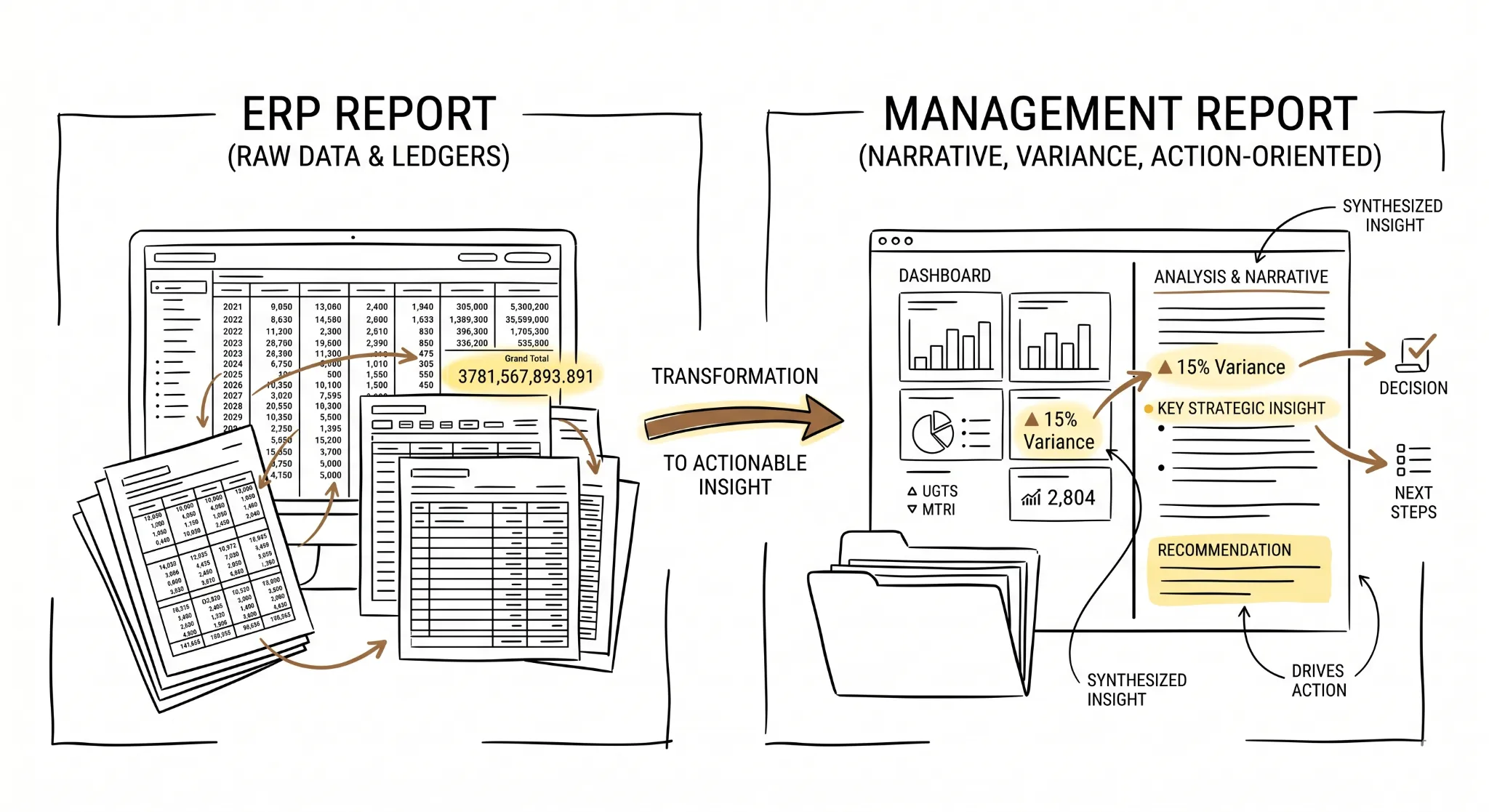
There is a fundamental difference between an accounting output and business intelligence.
Standard SAP Business One financial reporting can show you a trial balance, a generic P&L, and a list of transactions. But management reporting is about narrative and context. Leadership needs variance explanation, entity comparisons, margin analysis, and actionable insights.
When the board asks why EBITDA dropped in a specific business unit, a static balance sheet won't answer them. A true board reporting pack requires KPI alignment, scenario planning, and financial analysis that connects operational drivers to financial outcomes. Generating a ledger export is easy; generating a comprehensive, narrative-driven management report is a different discipline entirely.
Multi-Entity Reporting Creates the Real Reporting Bottleneck
The breaking point for SAP Business One reporting usually arrives with multi-entity complexity.
Once a business scales to include multiple legal entities, subsidiaries, or joint ventures, the reporting workload explodes. Finance must now manage complex roll-ups, navigate mapping inconsistencies across different entities, and perform tedious intercompany eliminations.
Generating reports for a single entity is manageable; generating consolidated group reporting that the executive team can confidently trust is a massive operational hurdle. Without financial reporting automation, multi-entity reporting devolves into a web of linked spreadsheets where a single broken formula can compromise the entire board pack.
Cash Visibility Still Breaks Outside the ERP
Even with a tightly controlled ERP, cash understanding often sits in fragmented silos.
SAP Business One knows your current bank balances and recorded payables. However, true cash flow forecasting requires more. It demands visibility into bank portals, nuanced receivables expectations, payables pressure, and entity-specific liquidity context.
Finance still has to manually assemble the true picture to understand the company's actual cash runway. When cash visibility is fragmented across the ERP, bank feeds, and spreadsheets, finance spends its time reconciling contradictions instead of advising leadership on strategic capital deployment.
5 Signs Your ERP Reporting Layer Is Still Manual
Software alone does not fix broken finance operations—process discipline matters. While Excel works for lower-complexity workflows, and traditional BI tools (like Power BI or Tableau) offer data visualization, they often lack the finance-native logic required for true FP&A modernization.
Here is a practical checklist to determine if your ERP reporting layer is holding you back:
- You export from SAP Business One every month to build leadership reports.
- Your reporting pack depends on Excel logic only one person understands.
- Intercompany and consolidated reporting require manual adjustments.
- Cash reporting lives across ERP data, bank portals, and spreadsheets.
- Leadership asks “why?” and finance has to investigate after the meeting.
The Missing Layer Between ERP Data and Finance Decisions
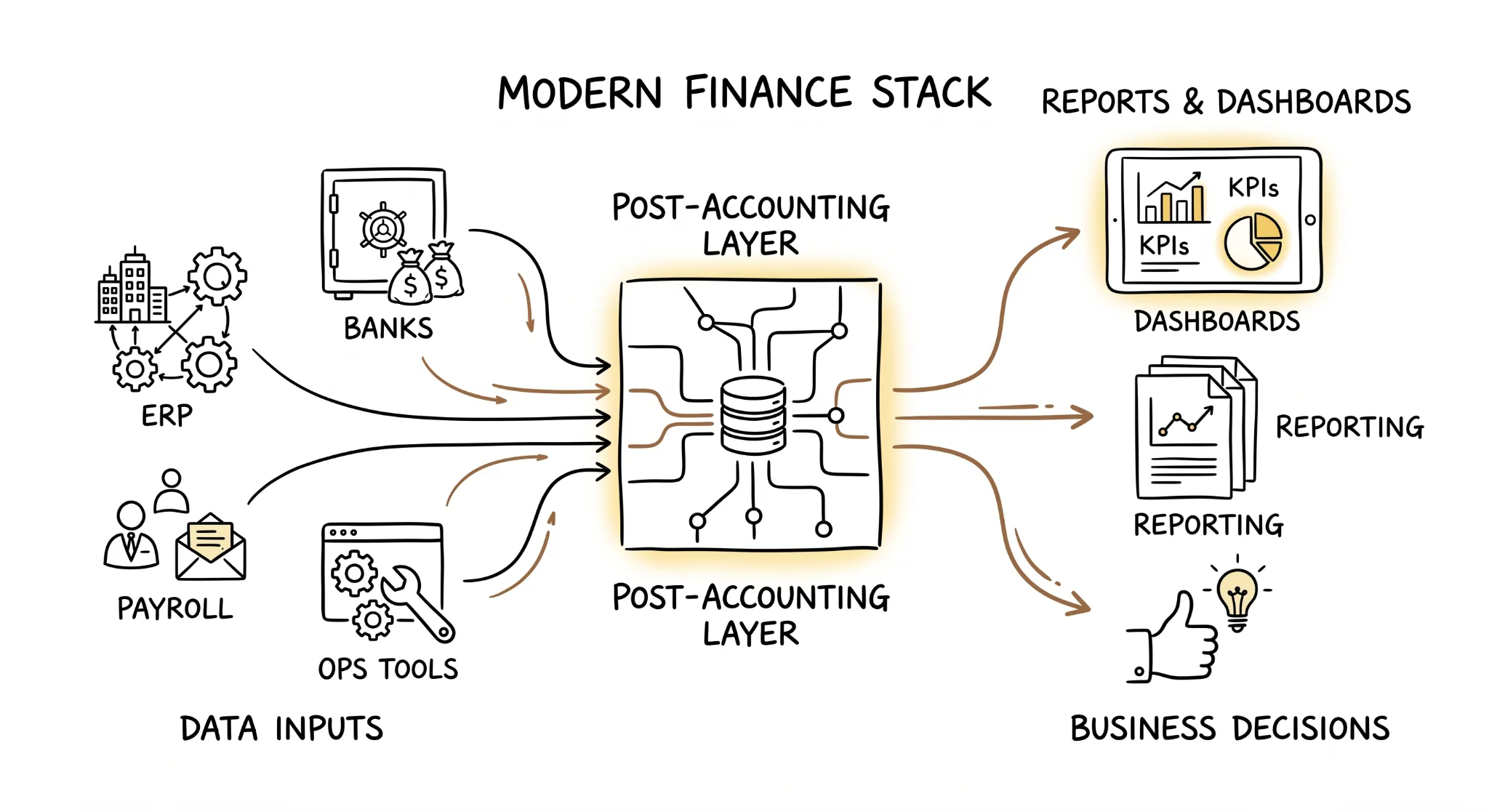
What a growing finance team actually needs is not to replace SAP Business One, but to augment it. They need a post-accounting layer that sits above the ERP and translates raw data into executive clarity.
This missing layer must provide:
- Automated management reporting
- Seamless consolidated reporting
- Finance-native logic and chart of accounts mapping
- Automated intercompany handling and eliminations
- Clear KPI alignment
- Unified cash visibility and forecasting inputs
- Repeatable workflows with full auditability and consistency
- Faster answerability for leadership questions
By adding this layer, finance teams elevate their role from data aggregators to strategic advisors.
The Solution: Bridging the Gap
For many finance teams, this is the point where ERP control needs a reporting layer above it. The goal is not to replace the ERP foundation. It is to make reporting faster, clearer, and more finance-native.
This is where Kudwa comes in. Kudwa acts as the post-accounting layer that sits on top of systems like SAP Business One. It takes structured ERP data, combines it with fragmented finance inputs, and turns it into clearer management reporting, consolidated visibility, better cash insight, and highly usable financial analysis.
This is where teams move from Excel-heavy reporting to a more structured post-accounting workflow, giving CFOs and finance leaders the confidence and speed they need to guide the business.
Moving Beyond the Excel Rebuild
SAP Business One is a vital tool for establishing structure, centralizing operational data, and maintaining accounting control. But as growing companies face increasing operational complexity, multi-entity structures, and the demand for rapid executive insights, relying on standard ERP reports—and the inevitable Excel rebuilds—is no longer sustainable.
Growing finance teams need a dedicated layer for management reporting, consolidated visibility, and deeper cash understanding to truly modernize their FP&A capabilities.
Ready to stop rebuilding reports? See how Kudwa works on top of your ERP and finance stack in a quick demo.
Latest from Kudwa

5 Best AI Finance Tools in the UAE for 2026
Every finance platform now talks about AI. The harder question for UAE finance teams is which tools actually remove work and earn their place in the stack.

Finance Software ROI: How to Judge Your CFO's Next Request
A $30,000 software request looked like overhead. Six months later it cost $200,000 in margin. How to judge finance software ROI before you decline.