The "Visibility Paradox": Why Growing Your Entity Count Shrinks Your Cash Control
The larger your footprint in the GCC, the harder it is to see where you actually stand. This guide explores how to reclaim control.

From Fragmented Chaos to Near-Real-Time Liquidity Command in the GCC
The larger your footprint in the GCC, the harder it is to see where you actually stand. In 2026, many finance teams find that adding business units creates a "Visibility Paradox": more data points result in less clarity. This guide explores how to reclaim control.
At-a-Glance Executive Summary
- The Post-Mortem: Traditional month-end cash flow statements act as autopsies rather than real-time diagnostics.
- Spreadsheet Friction: Manual reconciliation across entities is the killer of finance team productivity.
- System Silos: Disconnects between bank data, ERPs, and payroll tools create "blind spots" in short-term liquidity.
- Forecasting Gap: Historical reporting is often decoupled from forward-looking scenario planning, making "what-if" analysis a guess.
- Inter-company Fog: In multi-entity setups, internal transfers often mask the true group-level liquidity position.
- Leading Indicators: Most teams ignore DSO and DPO trends until the cash conversion cycle has already stretched too thin.
- Compliance Weight: Relying solely on IAS 7 (Indirect Method) for internal decisions provides too little granular detail for operations.
The $2 Million "Ghost" Balance
Imagine you are the CFO of a high-growth holding group in Dubai. You have four trade licenses, three distinct business units, and a lean finance team of five. On a Tuesday morning, the CEO asks: "Can we greenlight the KSA expansion and pay the warehouse deposit this week, or will it trigger a covenant breach?"
You look at your dashboard. The accounting software says you have $2M in "Cash at Bank." But that data is from the month-end close ten days ago. Since then, three inter-company transfers happened, payroll for the Abu Dhabi entity cleared early, and a major client in Riyadh delayed a payment.
The reality? You don’t have $2M. You have $450k in available liquidity and a looming VAT payment.
In the GCC, we scale fast by spinning up entities. But each new entity adds a layer of "Finance Fog." You aren't lacking reports; you are lacking a connected cash reporting system that supports decisions in the moment.

1. Moving Beyond the "Accounting Autopsy"
Most companies rely on the Statement of Cash Flows—a backward-looking document designed for compliance and auditors. Under IAS 7, the indirect method is standard, but it’s a "reconciliation," not a "roadmap."
In 2026, the modern standard is continuous visibility. This means layering a direct method view, actual cash-in and cash-out, over your accrual accounting. If you can't see your cash position with 48-hour freshness, you are driving a car by looking through the rearview mirror. That freshness requires cash visibility that updates in real time across every entity and bank.
2. The Multi-Entity "Black Box" Problem
For GCC groups, the challenge is often Treasury Visibility. When cash is trapped in a subsidiary’s account or tied up in intercompany receivables, the group-level view is distorted.
Modern Operational Finance requires a consolidated view that automatically eliminates intercompany noise. This allows you to see "Net Group Liquidity" without spending three days in Excel.
That's the specific problem multi-entity consolidation solves: automated eliminations, FX adjustments, and a single group view without the manual work.
3. Connecting Leading Indicators to the Bottom Line
Cash flow reporting shouldn't start at the bank; it should start at the Cash Conversion Cycle (CCC).
- If DSO (Days Sales Outstanding) ticks up by 4 days in your tech division, that’s a cash crunch 30 days from now.
- If DPO (Days Payable Outstanding) is too low, you’re essentially giving interest-free loans to your suppliers.
A sophisticated 2026 dashboard connects these leading indicators directly to your Operating Cash Flow forecast.
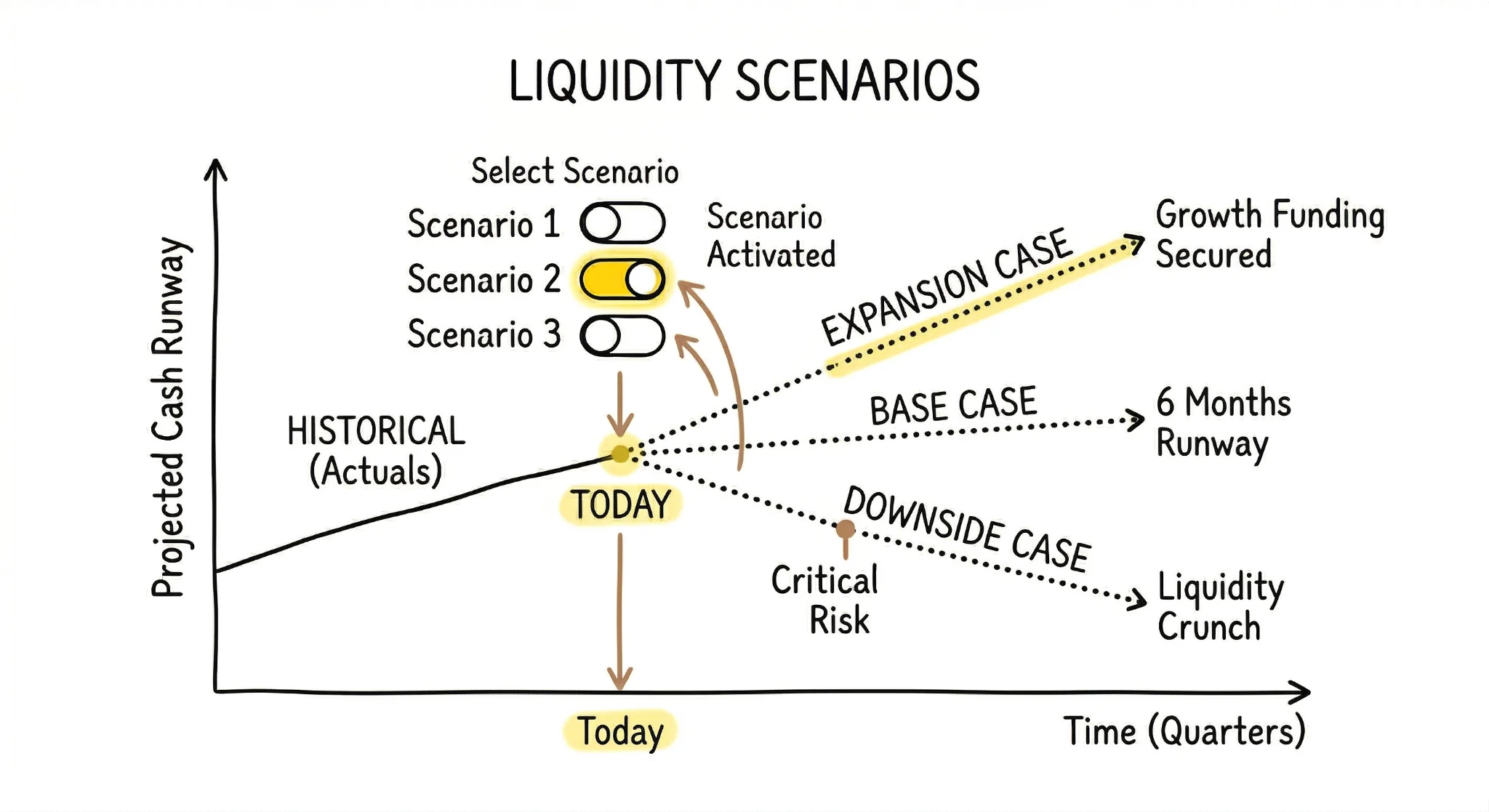
4. Scenario Planning: From "Guesswork" to "Data-Backed Strategy"
Static budgets are dead. The most resilient finance teams now use Scenario Planning as a weekly exercise.
- Base Case: Everything goes as planned.
- Downside: A 15% drop in collections + a 10% spike in Opex.
- Expansion: Hiring 10 new engineers + a new office lease.
By tying these scenarios to actual live data, you move from "I think we can afford this" to "The data shows we have 6 months of runway under the downside case."
The Solution: Building a Modern Finance Command Center
If you are a small startup, Excel is your best friend. It’s flexible and free. But once you hit the $1M+ revenue mark with multi-entity complexity, Excel becomes your biggest risk. One broken VLOOKUP can hide a million-dollar liquidity gap.
You could try to build a custom solution inside a legacy ERP, but that often takes 6 months and a $50k consultant fee.
The alternative is an AI-native FP&A layer like Kudwa. Kudwa doesn't replace your accounting software (like Xero, Zoho, or Oracle); it sits on top of it. It acts as the "Enabler" that:
- Connects your fragmented systems (Accounting, Bank, Payroll).
- Automates the "stitching" of multi-entity reports.
- Visualizes cash flow with the "Direct Method" clarity that CEOs actually understand.
The goal isn't just to "do the reporting", it's to give the CFO the "Sword of Clarity" needed to slay the dragons of risk and uncertainty.
Stop Reporting the Past. Start Guiding the Future.
The transition from a "Month-End" mindset to a "Real-Time" mindset is the hallmark of a modern finance leader. By focusing on automated connectors, leading indicators, and scenario-ready data, you transform finance from a back-office function into a strategic engine.
Ready to see what your cash flow looks like when it's actually connected?
Latest from Kudwa

Deferred Tax in Multi-Entity Consolidation: The DTA No UAE Entity Return Shows
Every entity return reconciles, yet the group is short a DTA. See where deferred tax in multi entity consolidation hides in eliminations, and how to measure it.

Segment Reporting vs Entity Reporting: Building a Business-Line View That Survives the Close
The analyst who splits the trading entity was out, so distribution vanished from the board pack. Segment reporting vs entity reporting needs a written map.