Unified Financial Data Platform vs BI vs ERP: How Finance Teams Choose the Right Layer
A unified financial data platform is not accounting software, an ERP, or a BI dashboard.

Executive summary
- Layer mismatch: Many finance teams buy BI, ERP modules, or reporting tools when the real gap is the data layer between systems.
- Accounting role: The accounting system records transactions, but it does not always prepare cross-system answers for leadership.
- BI role: BI visualises prepared data, but it does not automatically reconcile finance logic, entity mappings, bank data, payroll, AR, AP, and spreadsheet assumptions.
- ERP role: ERP can standardise operations, but it may be too broad if the problem is finance visibility across existing tools.
- Unified layer: A unified financial data platform connects and prepares data from existing systems so finance can report, explain, and analyse from one controlled view.
- Decision test: If the same reporting problem remains after dashboards improve, the bottleneck was probably not visualisation.
- Practical rule: Buy the layer that matches the failure. Recording, workflow, visualisation, and finance data preparation are different problems.
The dashboard is finished.
It has clean charts, filters by entity, and a board-ready revenue view.
Then the CFO asks why cash fell while revenue increased.
The BI dashboard shows the movement. It does not explain it.
The answer still requires someone to open the accounting export, bank balances, AR aging, AP schedule, payroll file, and forecast model. The finance team did not buy a bad BI tool. It bought the wrong layer for the problem.
This is where the category of unified financial data platform gets misunderstood.
A unified financial data platform is not better accounting software. It is not an ERP replacement. It is not another dashboard. It is the finance data layer that sits between source systems and the reports, forecasts, dashboards, and leadership questions that depend on them.
The difference matters because many finance teams do not have a tooling problem in general.
They have a layer problem.
A unified financial data platform solves the layer between recording and reporting
Most finance stacks already have tools that do useful work.
The accounting system records transactions.
The bank portal shows cash movement.
Payroll processes employee costs.
Billing tracks invoices and collections.
The CRM holds customer and pipeline context.
BI visualises prepared datasets.
Spreadsheets handle flexible analysis, adjustments, and ad hoc work.
The problem starts when leadership asks a question that cuts across those boundaries.
For example:
Why did group cash decrease by AED 1.2M this month when revenue grew?
That question cannot be answered properly from one system.
The accounting system may show revenue and expenses. Bank portals show actual cash movement. AR shows what customers still owe. AP shows upcoming supplier pressure. Payroll explains one large cash outflow. The forecast model shows what finance expected. Intercompany activity may explain why one entity looks weak while the group remains stable.
A unified financial data platform exists to connect those pieces into a finance-ready view.
Not just a visual view.
A reconciled, traceable, decision-ready view.
That is why it should be evaluated separately from accounting software, ERP, and BI.
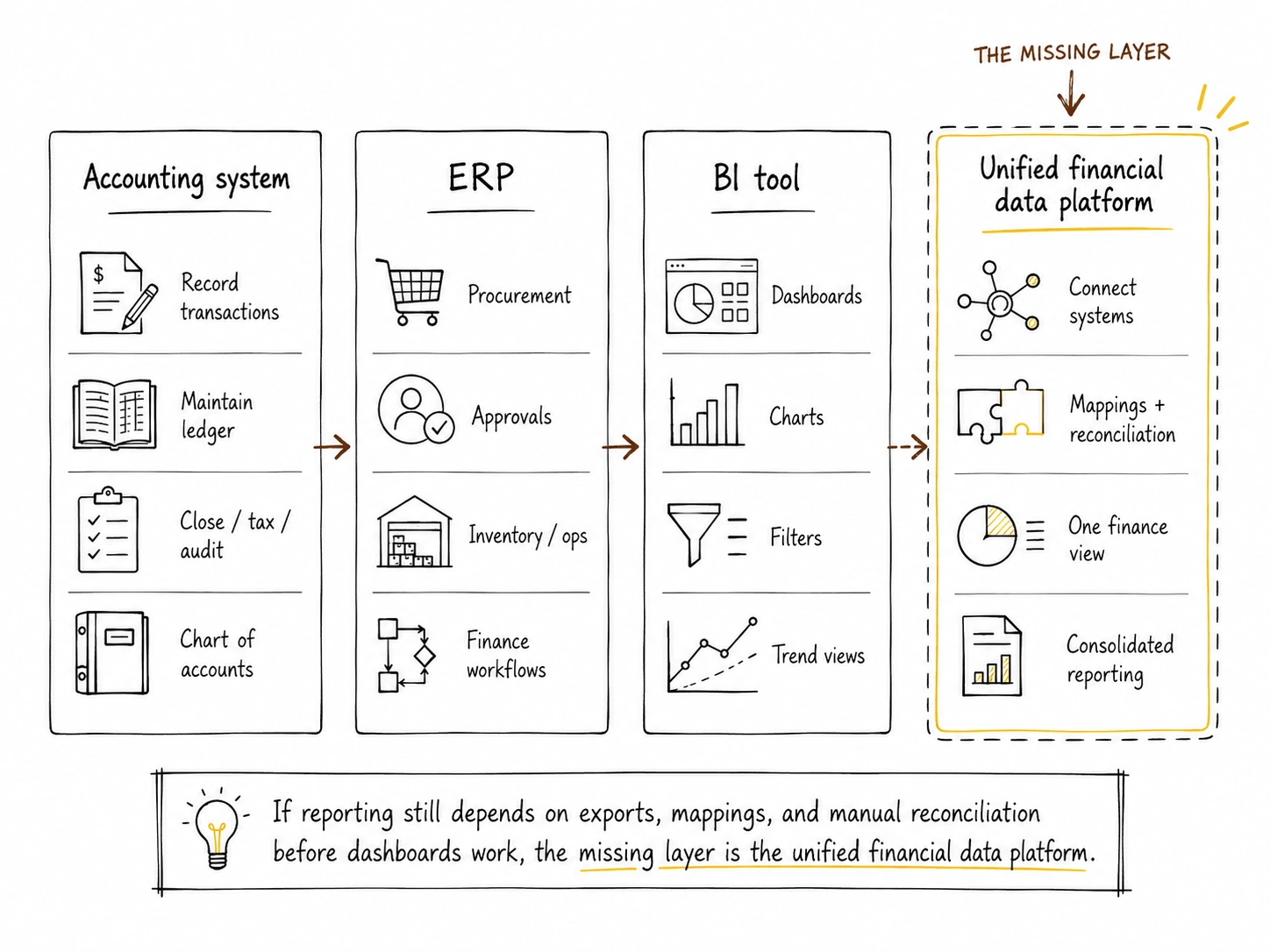
The four layers finance teams confuse
When a finance team says reporting is slow, that can mean several different things.
The wrong diagnosis leads to the wrong purchase.
Use this distinction first.
The key is not which tool sounds more advanced.
The key is where the failure happens.
If transactions are inaccurate, fix accounting.
If workflows are uncontrolled, consider ERP or process redesign.
If data is prepared but hard to consume, BI may help.
If the data has to be exported, cleaned, mapped, reconciled, and explained before anyone can trust the report, the missing layer is likely a unified financial data platform.
When accounting software is not the problem
Accounting software gets blamed for many issues it was not built to solve.
A clean ledger does not automatically create a clean management view.
The ledger records what happened according to accounting structure. Leadership usually wants to understand what happened according to business structure.
Those are not always the same.
A company may close properly and still struggle with:
- cash split across multiple banks and entities
- payroll detail sitting outside accounting
- billing data not matching revenue recognition timing
- customer names differing between CRM, billing, and ledger
- department mappings that live in spreadsheets
- forecast assumptions disconnected from actuals
- intercompany movements that obscure entity-level performance
None of those mean the accounting system is useless.
They mean the accounting system is being asked to answer questions outside its natural boundary.
That distinction matters because replacing accounting software can be expensive, disruptive, and still fail to solve the reporting problem.
If the issue is cross-system decision context, the finance team may not need a new ledger.
It may need a better layer above the ledger.
When BI is not enough
BI tools are often introduced when leadership wants speed.
The request sounds reasonable:
“We need dashboards.”
But dashboards only work as well as the data model beneath them.
If finance has to manually prepare the dataset before BI can visualise it, the reporting process has not been fixed. It has been dressed up.
Take a common example.
A finance team wants a dashboard showing revenue, collections, gross margin, cash, and payroll by entity.
The accounting system provides recognized revenue and expenses. The CRM provides customer and segment detail. Billing provides invoice status. Bank portals provide actual cash. Payroll provides employee cost by department. The forecast model sits in Excel.
The BI tool can display the final view.
But first, someone still has to decide:
- which customer name is correct
- which entity owns the revenue
- whether revenue should be shown as booked, invoiced, recognized, or collected
- how payroll departments map to management reporting lines
- whether cash includes restricted balances
- how intercompany transfers should be removed
- which period each source belongs to
That is finance logic.
BI can visualise it. It usually does not own it.
A unified financial data platform should sit before BI in this workflow. It prepares the finance view so that dashboards consume consistent, traceable data instead of one-off manual files.
When ERP is too much
Sometimes the reporting problem is used to justify a larger ERP conversation.
That may be right if the company has uncontrolled workflows, weak procurement controls, inventory complexity, fragmented operational approvals, or poor transaction discipline.
But ERP is not always the right answer for a finance visibility problem.
A company can have decent systems and still lack connected financial context.
For example, a UAE parent may use a cloud accounting system, a KSA entity may use another setup, regional bank portals may hold live balances, and payroll may sit in a local provider file. The group may not want to replace all of that immediately.
The issue is not always system ownership.
The issue is that finance cannot produce one current, explainable view across the stack without manual work.
In that case, forcing every process into one ERP may be slower than solving the finance data layer directly.
The stronger question is:
Do we need to change the systems that create the data, or do we need a better way to connect and prepare the data they already create?
The wrong-layer failure: faster charts, same manual bottleneck
Here is the failure pattern.
The company has slow reporting.
Finance spends days preparing management packs.
Leadership complains that the numbers arrive late.
The team buys BI.
The dashboards improve. The charts are cleaner. Filters make it easier to move by entity, month, and department.
But the reporting cycle still starts with exports.
Accounting data is pulled manually. Bank balances are downloaded. Payroll is copied in. AR and AP schedules are cleaned. Entity mappings are checked. Forecast assumptions are matched. Then the dataset is uploaded into BI.
The output improved.
The bottleneck remained.
The problem was never the chart. It was the uncontrolled data preparation work before the chart.
This is the main reason finance teams should not evaluate a unified financial data platform as “another dashboard.” The category solves a different problem.
It answers:
Can finance create a trusted view before reporting begins?
A practical diagnostic: which layer is missing?
Before buying anything, finance should diagnose the failure.
Use this decision checklist.
The cleanest test is this:
If the data is already trusted and structured, but hard to consume, BI may be enough.
If the data is not yet trusted, reconciled, or traceable across systems, BI is too late in the workflow.
The missing layer comes earlier.
What the unified platform should actually control
A unified financial data platform should not try to own everything.
It should control the finance view across systems.
That usually includes five jobs.
1. Source connection
The platform should connect to the systems finance depends on: accounting, banks, payroll, billing, AR, AP, CRM, spreadsheets, and relevant operational sources.
If the platform only accepts static uploads, it may still help. But the team should be clear that manual export work remains.
2. Finance mapping
The platform should standardise entities, departments, accounts, customers, vendors, currencies, and categories across systems.
This is where much of the hidden reporting work lives.
If “ABC Trading LLC” appears one way in accounting, another in the CRM, and another in billing, the platform should help finance create one controlled reporting identity.
3. Consolidated views
The platform should prepare views finance actually uses: group cash, entity performance, payroll by department, AR and AP exposure, management P&L, variance bridges, and forecast-to-actual comparisons.
The point is not to collect data for its own sake.
The point is to make recurring finance answers easier to produce and defend.
4. Traceability
Every reported figure should be explainable.
Finance should know where it came from, which source fed it, what mapping was applied, and whether any adjustment changed it.
Without traceability, reporting becomes presentation without control.
5. Decision context
The platform should help finance move from “what happened?” to “why did it happen?”
That means preserving enough detail to explain timing, customer movement, entity differences, payroll changes, collection delays, supplier payments, FX, and intercompany effects.
This is where unified financial data becomes more than a storage concept. It is the operating layer that prepares finance data for reporting and explanation.
Once the data is connected and traceable, finance analysis can focus on drivers and decisions instead of rebuilding inputs.
Where the earlier unified data conversation fits
There is a related but separate question:
What does a unified financial data platform replace in a growing finance stack?
That is about the manual stitching layer: exports, mappings, workbooks, offline cash trackers, reporting packs, and analyst memory. For that angle, the natural internal link is What a Unified Financial Data Platform Actually Replaces in a Growing Finance Stack.
This article is asking a different question.
Not “what does it replace?”
But “how do we know this is the right layer to buy?”
That distinction matters for CFOs because tooling decisions often fail at the diagnosis stage. A capable BI tool can disappoint if the real problem is unreconciled data. A full ERP project can become excessive if the real issue is management reporting visibility. A new accounting system can miss the point if the ledger is fine but operating context is scattered.
The right question is not:
Which tool is best?
It is:
Which layer is failing?
When a unified financial data platform becomes necessary
A unified financial data platform becomes necessary when finance already has tools, but no controlled way to turn their outputs into answers.
It is usually premature when:
- the company has one entity
- most finance data lives in one accounting system
- leadership asks for simple recurring reports
- cash sits in one or two accounts
- mappings rarely change
- one finance person can explain the full data flow without much effort
It becomes more necessary when:
- accounting, banks, payroll, billing, CRM, and spreadsheets all feed reporting
- group-level views require manual consolidation
- entity and department mappings change often
- different reports show different versions of the same metric
- finance spends more time preparing data than explaining performance
- leadership needs the reason behind the number, not just the number
- cash, forecast, and actuals need to connect
This is why lean finance teams often feel the pain first. They may not have the headcount to maintain a manual finance data layer every month. The issue is not that the team lacks effort. It is that the same preparation work keeps recurring. That connects directly to How Lean Finance Teams Can Run Serious Reporting Without Adding Headcount.
What finance should check before choosing one
Before choosing a unified financial data platform, finance should test it against the actual failure points.
Ask:
- Are we trying to fix recording, workflow, visualisation, or data preparation?
- Which systems create the data behind our key reports?
- Which parts of reporting still depend on exports?
- Which mappings live in spreadsheets or analyst memory?
- Can the platform connect to the systems we already use?
- Can it reconcile entity, department, account, customer, vendor, and currency differences?
- Can every figure be traced back to source?
- Can it support both current operating views and locked reporting views?
- Will BI or board reporting consume cleaner data after this?
- Will finance spend less time assembling the answer and more time explaining it?
The commercial test is simple.
If the tool only improves how data looks, it is not solving the unified layer.
If it improves how data connects, reconciles, traces, and becomes usable for decisions, it is closer to the right category.
This is where a post-accounting layer such as Kudwa can help: not by replacing accounting, ERP, or BI, but by sitting above existing systems and turning fragmented finance data into one connected view for reporting, cash visibility, and analysis.
The final takeaway:
A unified financial data platform is not the best version of every finance tool. It is the layer finance needs when the tools already exist, but the answer still has to be assembled by hand.
See how Kudwa sits on top of your existing systems and turns fragmented finance data into one connected view.
Latest from Kudwa

Deferred Tax in Multi-Entity Consolidation: The DTA No UAE Entity Return Shows
Every entity return reconciles, yet the group is short a DTA. See where deferred tax in multi entity consolidation hides in eliminations, and how to measure it.

Segment Reporting vs Entity Reporting: Building a Business-Line View That Survives the Close
The analyst who splits the trading entity was out, so distribution vanished from the board pack. Segment reporting vs entity reporting needs a written map.