The Power BI Ceiling: Why Your Dashboards Stop Where Your Finance Strategy Begins
Stop spending 80% of your time on manual data plumbing. Learn why Power BI hits a ceiling for GCC finance teams and how to automate trusted insights.

How to move from Consultant-Dependent Reporting to Autonomous Financial Mastery in the GCC
The most dangerous state for a CFO is "apparent certainty." You look at a beautifully rendered Power BI chart showing a healthy EBITDA trend, but deep down, you know that data was manually stitched together from three different ERPs and an offline spreadsheet just an hour before the board meeting. This is the Reporting Deadlock: the point where your visualization tool looks sophisticated, but your underlying Operational Finance remains manual, fragile, and dangerously slow.
At-a-Glance Executive Summary
- Financial Drain: Power BI implementation often requires a massive upfront investment in time and capital.
- Resource Prison: Dependence on external BI consultants or internal data scientists for simple report changes.
- User Friction: Non-intuitive interfaces that strip the "power" from the finance team's hands.
- Integration Gap: Lack of native, finance-aware connectors to popular Cloud Accounting software.
- Rigid Architecture: Inability to pivot or adjust reporting logic without breaking the entire data model.
- Missing Planning: No out-of-the-box functionality for Budgeting vs. Actuals comparison.
- Analysis Void: Absence of AI in Finance tools built specifically for Variance Analysis and Scenario Planning.
The "Gatekeeper" Conflict
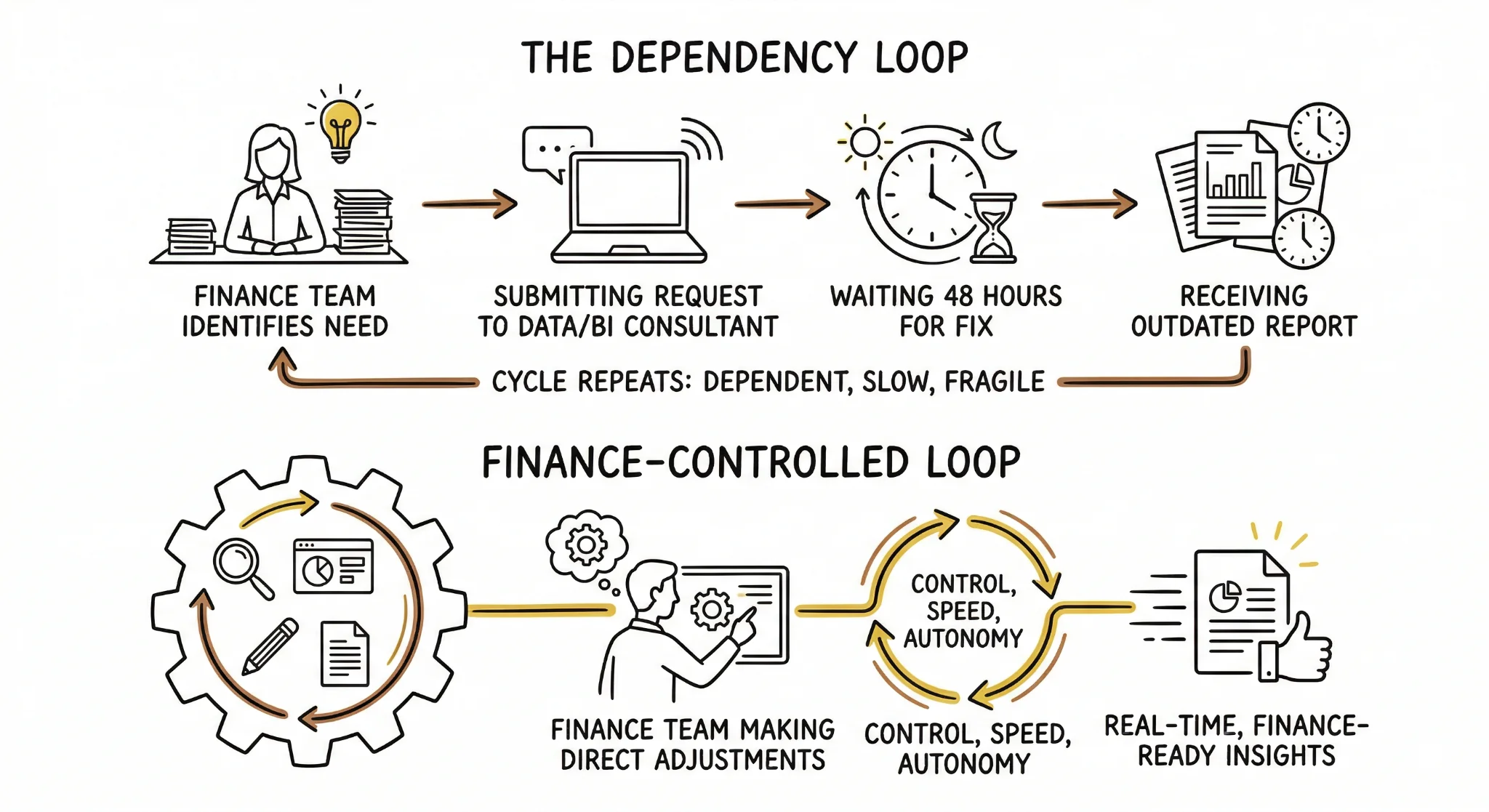
Imagine a CFO of a hyper-growth group in Riyadh. They’ve just successfully expanded from two entities to five. The board demands a consolidated Cash Visibility report by Monday. The CFO opens their Power BI environment only to find the new entity isn't showing up because the "DAX formula" for currency conversion has broken.
To fix it, they can't just click a button. They have to call an external consultant—at $200 an hour—who isn't available until Tuesday. This is the reality for many GCC finance leaders: they own the data, but they don't own the tool. Instead of being an agile partner to the CEO, the finance team becomes a "ticket submitter" in their own department.
The deeper issue is that general BI tools weren't built to understand finance logic — finance-native AI analysis handles variance, anomalies, and driver explanations without a consultant in the loop.
The Hidden Debt of General-Purpose BI
1. The Setup Tax: High Costs and Long Lead Times
While Power BI licenses might seem affordable, the total cost of ownership is staggering. For a company doing $10M+ revenue, a custom finance build-out can take 3 to 6 months and cost tens of thousands of dollars in implementation fees. For lean finance teams, this "Setup Tax" is a barrier to FP&A Modernization.
2. The Consultant Trap: Losing Your Autonomy
Power BI is a developer’s tool, not a finance professional’s tool. When you need to change how OPEX is categorized or adjust an Intercompany Elimination, you shouldn't need a computer science degree. When the power to edit reporting logic is held by an external resource, your ability to provide Advisory insights is throttled by someone else's schedule.
3. "Connected" but not "Integrated"
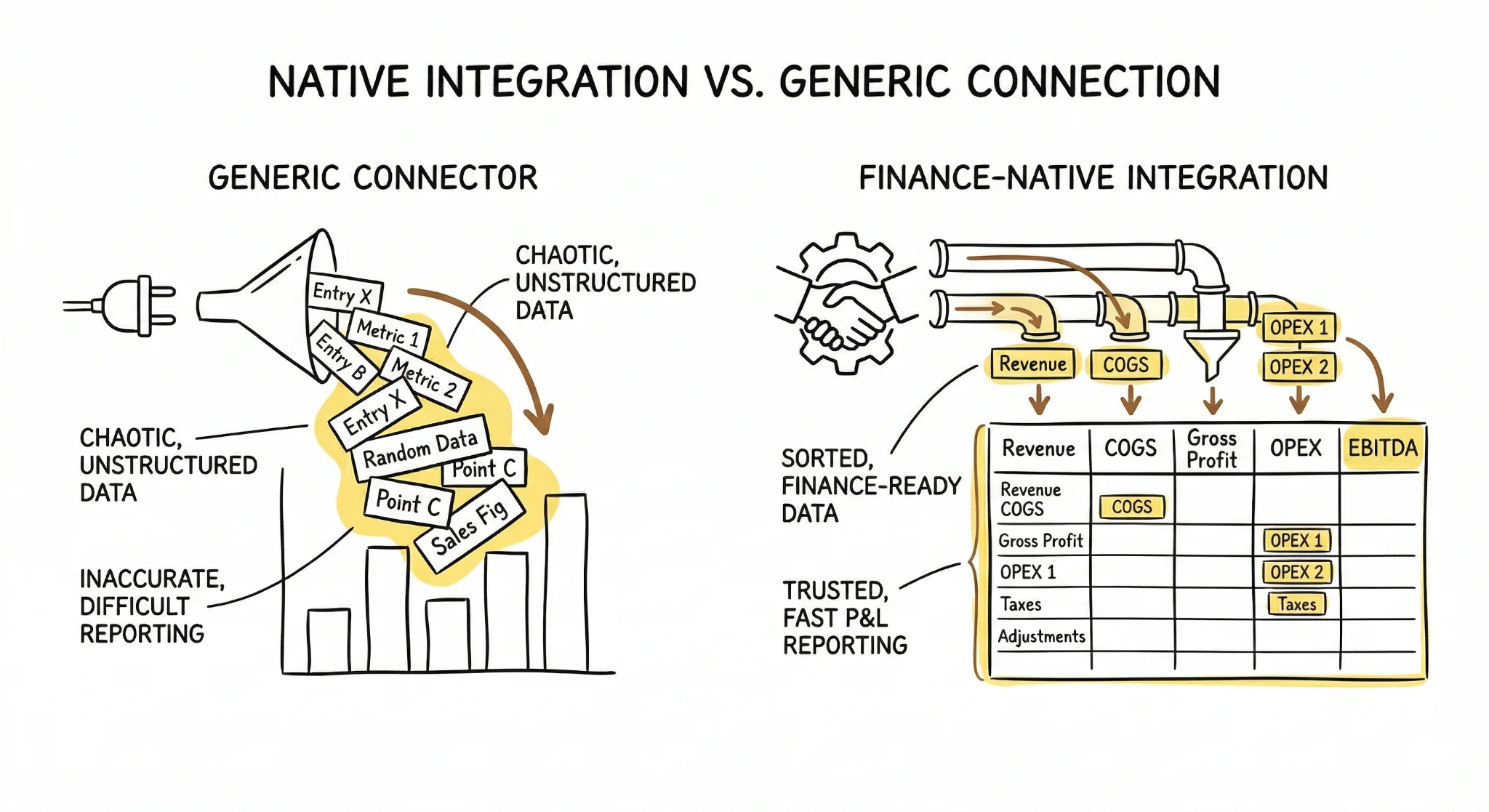
Power BI offers "connectors," but it doesn't offer "context." It pulls raw data tables but doesn't understand your Accounting logic. It doesn't know what a "Prepayment" is or how a "Journal Adjustment" affects your Reconciliation. You are left to manually map data every time you want a trusted Management Reporting pack.
4. The Budgeting Blind Spot
Finance isn't just about looking at the past; it’s about comparing it to the plan. Power BI does not handle Budgeting natively. To see your "Budget vs. Actuals," you typically have to upload a static CSV file and hope the mapping matches perfectly. If your budget changes mid-year (as it often does in the volatile GCC market), you are back to square one.
5. Why Generic AI Fails the CFO
General-purpose AI might help you write a query, but it doesn't provide Agentic AI insights. It won't tell you, "Your OPEX in the Dubai entity is 15% higher than the Riyadh entity due to a spike in logistics costs." Without finance-native AI analysis, you are still doing the heavy lifting of finding the "why" behind the numbers.
The Solution: The Shift to a Post-Accounting Layer
The fix isn't necessarily to delete Power BI, it's to stop using it as your primary finance engine. Leading CFOs are adopting a Post-Accounting Layer like Kudwa that sits between their messy data and their final reports.
This layer handles the "Finance Heavy Lifting" automatically:
- Instant Setup: Connect your Cloud Accounting and see a consolidated P&L in minutes, not months.
- Total Ownership: Change your mapping or consolidation rules yourself, with no consultants required.
- Built-in Planning: Native Budgeting and Scenario Planning that actually talks to your actuals.
- Autonomous Analysis: AI that understands VAT / Tax Compliance and Variance Analysis specifically for SMEs and mid-market firms.
By using a tool built by finance experts for finance experts, you move from a state of "data janitor" to "strategic architect."
Take Back the Power
If you are currently waiting on a consultant to tell you what your Cash Flow looks like, you aren't in control of your strategy. Power BI is a great tool for the marketing team's click rates, but your Financial Analysis deserves a foundation built for high-stakes accuracy and speed.
The era of waiting for "Data Scientists" to explain your financials is over. It's time to put the power back into the hands of the Finance Department.
Stop maintaining your reports and start using them. See how Kudwa gives you a 100% Finance-Native visibility in 5 minutes →
Latest from Kudwa

Deferred Tax in Multi-Entity Consolidation: The DTA No UAE Entity Return Shows
Every entity return reconciles, yet the group is short a DTA. See where deferred tax in multi entity consolidation hides in eliminations, and how to measure it.

Segment Reporting vs Entity Reporting: Building a Business-Line View That Survives the Close
The analyst who splits the trading entity was out, so distribution vanished from the board pack. Segment reporting vs entity reporting needs a written map.