Best Business Finance Platforms for Small Accounting Teams Without Adding Headcount: What to Evaluate Before You Hire
The best business finance platforms for small accounting teams without adding headcount remove manual reporting assembly, connect your data, and more.

Executive summary
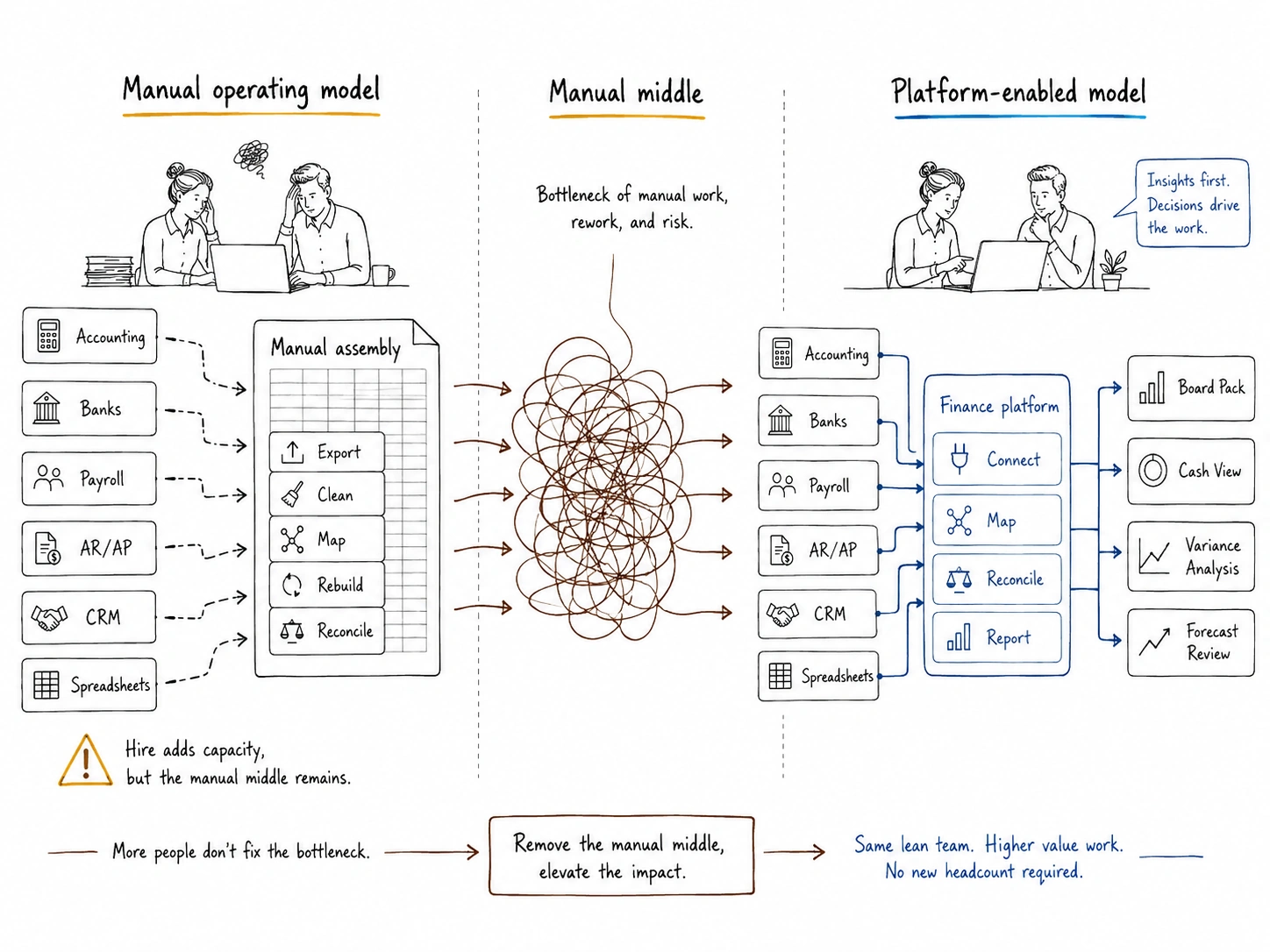
- Wrong reflex: When small accounting teams are stretched, hiring feels like the obvious fix, but the real constraint is often manual assembly.
- Hidden work: Much of the week is lost to exports, mappings, reconciliations, and rebuilding reports that should already exist.
- Bad scaling: Adding people to a manual process increases capacity, but it does not remove the structural bottleneck.
- Right platform: The best business finance platforms connect source systems, preserve reporting logic, and produce repeatable outputs without rebuilds.
- Finance leverage: A two-person team can operate closer to a larger team when the platform absorbs the manual middle.
- Decision test: If the hire is mainly needed to speed up manual reporting work, first test whether the work should exist at all.
- Practical outcome: The goal is not to avoid hiring forever. It is to stop hiring people to maintain broken workflows.
A finance lead asks for a second analyst.
Month-end takes the full team a week. The board pack takes another two days. Cash reporting depends on three bank exports. Payroll needs to be reconciled manually. The CEO keeps asking for variance explanations that take hours to trace.
Before approving the hire, the CFO asks a simple question:
What is the week actually spent on?
The answer is uncomfortable.
Exporting from four systems. Reconciling them in Excel. Rebuilding the same management report that broke last month. Checking whether the cash file matches the accounting file. Updating mappings that live in one person’s spreadsheet.
That is not finance work.
It is assembly work.x
The hire may help. But if the new person is added to the same workflow, the company has not fixed the constraint. It has added salary cost to a process that should have been redesigned.
This is where the search for the best business finance platforms for small accounting teams without adding headcount should begin.
Not with features.
With the question: are we short on people, or are we asking people to do work a system should absorb?
The best business finance platforms for small accounting teams without adding headcount remove assembly first
A small accounting team usually does not fail because it lacks effort.
It fails because the operating model asks too much manual coordination from too few people.
The accounting system holds the ledger. Bank portals hold cash movement. Payroll holds employee cost. AR and AP schedules sit elsewhere. Forecast assumptions may sit in Excel. The board pack needs all of it.
At small scale, this is manageable.
One person knows the files. One person owns the workbook. One person understands which bank balance is current, which entity needs adjustment, and which payroll category maps to management reporting.
The process works because the business is simple enough for memory to cover the gaps.
Then the company grows.
More entities. More bank accounts. More departments. More systems. More leadership questions. More reporting cadence. Monthly becomes weekly. Weekly becomes “can we see this before the meeting?”
The finance team doesn't suddenly become less capable.
The manual middle gets too large.
A business finance platform should reduce that middle. It should connect the systems, preserve the reporting logic, and produce repeatable finance outputs without forcing the team to rebuild the same view every cycle.
That is the distinction between adding capacity and adding leverage.
Hiring helps when the work is finance work
Hiring is not wrong.
Sometimes it is necessary.
A small team may genuinely need another person if the workload includes more judgment, more control ownership, more stakeholder support, more collections management, more budget ownership, more scenario planning, or more close review.
Those are finance activities.
They require skill, context, and accountability.
The problem is hiring for work that should not be manual in the first place.
If the role description is effectively:
- export reports from accounting
- download bank balances
- paste payroll data into the reporting file
- maintain entity mappings
- update the same board pack every month
- reconcile why the dashboard does not match the spreadsheet
- clean data before anyone can analyse it
then the company may not need an analyst first.
It may need a better platform layer.
A finance hire should improve judgment, control, analysis, and business support. They should not become the human API between disconnected systems.
The failure mechanism: scaling people against a structural problem
The common failure looks like this.
A two-person finance team is overloaded. Month-end reporting takes too long. Leadership wants faster answers. The CFO approves a third analyst.
At first, things improve.
The team can split the work. One person owns the accounting export. Another handles banks and cash. The third updates the reporting workbook.
The board pack lands earlier.
But the underlying process has not changed.
Now three people maintain three parts of the same spreadsheet logic. One person changes the payroll mapping. Another updates the entity file. A third adjusts the cash report. When the CEO asks why EBITDA changed, the team still has to trace through multiple files.
The bottleneck was not only workload.
It was manual consolidation between systems.
The cost went up. The structural problem stayed.
This is the mistake small accounting teams need to avoid. If the work scales only by adding people, the process becomes more expensive every time complexity increases.
What small teams actually need from a business finance platform
The right platform does not replace the accounting team.
It removes work that should not depend on individual effort every month.
Use this capability map.
The platform should not just make reports look cleaner.
It should reduce the number of manual steps before the report exists.
That is the practical test.
If the team still spends most of the week preparing the data before using the tool, the platform has not solved the headcount problem. It has added another destination for manual work.
What complexity changes for a small accounting team
Small teams can handle complexity for a while because they are close to the details.
That is also what makes the risk harder to see.
The process often depends on the same people being available, careful, and familiar with every exception.
Complexity increases in five specific ways.
1. Source systems multiply
One accounting system and one bank portal can be managed manually.
Add payroll, billing, CRM, AP, AR, regional banks, and entity-level spreadsheets, and the finance team starts coordinating data rather than using it.
The issue is not only more data.
It is more mismatched data.
2. Reporting cadence increases
Monthly reporting gives the team time to rebuild.
Weekly reporting exposes the weakness.
The finance team cannot spend two days rebuilding a report every week and still have time to explain what changed.
When reporting cadence increases, manual assembly becomes the constraint.
3. Leadership asks for analysis, not just numbers
A management report that shows payroll increased is not enough.
Leadership asks why.
Was it headcount? Bonus timing? Contractor reclassification? One entity? One department? A late posting? A payroll accrual? FX?
If the answer requires opening several source files, finance is not ready for fast analysis.
The data may exist.
The explanation is not connected.
4. The spreadsheet owner becomes a risk
Every small finance team has someone who “knows the file.”
That person understands the tabs, mappings, formulas, exceptions, and workarounds.
This works until they are unavailable, overloaded, or wrong.
The risk is not only that the spreadsheet breaks. The risk is that reporting logic becomes personal knowledge instead of system logic.
5. Growth outruns manual maintenance
A small team can absorb new complexity for a while.
Then the business adds another entity, bank, department, or reporting requirement.
The team does not just do more work. It maintains more links between systems.
At that point, hiring may feel urgent. But the deeper question is whether finance is scaling a process that should not be people-dependent.
A platform is necessary when the hire would mainly speed up manual reporting
The cleanest test is this:
What would the new hire spend the first 90 days doing?
If the answer is mostly finance judgment, stakeholder support, close ownership, forecast review, collections discipline, or control improvement, hiring may be the right move.
If the answer is mostly exporting, cleaning, mapping, rebuilding, formatting, and reconciling, the company should test tooling first.
A system becomes necessary when the team needs to remove manual assembly rather than add capacity to it.
The platform should:
- connect source systems so data does not need repeated export
- produce recurring reports without rebuilds
- keep reporting logic in the system, not in one person’s file
- preserve links back to source data
- support cash visibility, management reporting, and analysis from the same connected base
- free finance hours for interpretation rather than preparation
This is the operating idea behind What a Unified Financial Data Platform Actually Replaces in a Growing Finance Stack. The platform does not replace the finance team. It replaces the fragile manual layer the team has built between systems.
GCC example: lean team, high complexity
This is especially common in GCC mid-market companies.
A group may deliberately keep finance headcount lean while operating across multiple entities, banks, currencies, and accounting setups.
For example:
A UAE parent has two subsidiaries. One uses Zoho Books. Another uses QuickBooks. Payroll is managed through a local provider. Cash sits across AED and SAR bank accounts. The board wants monthly group reporting and weekly cash visibility.
The team has two finance people.
Both are capable.
But every reporting cycle requires:
- exporting ledger data
- downloading bank balances
- checking payroll files
- mapping entity names
- adjusting intercompany transfers
- preparing the board pack
- explaining why this week’s cash does not match last week’s view
A third hire may reduce pressure.
But if the process stays the same, the group has only added another person to the reporting machine.
The stronger fix is to connect the data layer so the team can produce group reporting and cash analysis without rebuilding the base every time.
This is also why the companion article How Lean Finance Teams Can Run Serious Reporting Without Adding Headcount works as the next read. That article covers the broader operating strain. This piece is narrower: how to evaluate the platform before hiring.
What the best platforms should let a small team do
The best business finance platforms for small accounting teams without adding headcount should help a small team operate with the reporting leverage of a larger one.
That does not mean replacing finance judgment.
It means giving finance a cleaner operating base.
A strong platform should help the team produce:
Management reporting without rebuilding the pack
The board pack should not start from a blank or broken workbook every month.
The reporting structure should already exist. The data should refresh into it. Finance should spend its time reviewing the story, not reconstructing the file.
Cash visibility without logging into every bank
Cash visibility should not depend on someone manually pulling balances from each portal.
The team needs one view of cash across entities, currencies, and accounts, with enough detail to explain what is usable, restricted, pending, or timing-related.
Variance analysis without reopening six files
When leadership asks why performance moved, finance should not have to reopen accounting exports, payroll files, AR schedules, and bank statements separately.
The platform should preserve enough connected detail to explain the movement.
Forecast support without manual actuals matching
Forecasting fails when actuals have to be manually cleaned before comparison.
A stronger setup connects actuals, cash movement, and operating inputs so finance can spend more time reviewing assumptions and less time matching files.
Shared reporting logic without key-person dependency
The logic behind the report should not live only in one person’s memory.
Entity mapping, account grouping, department logic, cash treatment, and reporting definitions should be controlled and visible.
This is where connected finance data matters. It gives the team one place to bring together the data that reporting and analysis depend on.
Once the base is connected, reporting and analysis becomes less about rebuilding inputs and more about explaining what changed, why it changed, and what leadership should do next.
Evaluation checklist before adding headcount
Before hiring for reporting capacity, finance should run a simple diagnostic.
Question
What it reveals
Confirms whether the platform improves analysis, not just speed
The last question matters.
A platform should not only make the team faster. It should change what the team has time to do.
If saved hours go into better cash review, better forecast assumptions, stronger board narratives, and faster variance explanation, the business gets more finance capability without adding headcount immediately.
If saved hours only create a prettier version of the same report, the platform has not gone far enough.
What finance should avoid when evaluating platforms
Small teams should be careful with tools that solve only the visible part of the problem.
Avoid evaluating platforms only by asking:
- Does it have dashboards?
- Does it export reports?
- Does it look easy to use?
- Can it connect to one accounting system?
- Can it generate charts?
Those questions are useful, but incomplete.
The better questions are:
- Does it reduce exports?
- Does it preserve reporting logic?
- Does it connect the systems behind our recurring reports?
- Does it support entity and account mapping?
- Does it keep figures traceable?
- Does it reduce dependency on one person’s workbook?
- Does it help answer follow-up questions faster?
- Does it make the next hire more valuable because they analyse instead of assemble?
This is where many tools fall short.
A dashboard may improve presentation without reducing preparation.
A reporting template may improve formatting without solving source fragmentation.
A spreadsheet add-on may speed up one file while keeping the same key-person risk.
The right platform should remove recurring coordination work from the team’s week.
The stronger hiring question
The question is not:
Can we avoid hiring?
That is too simplistic.
The better question is:
What should the next hire be used for?
If the next hire is needed to improve controls, own business partnering, strengthen forecasting, manage collections, or support strategic planning, that may be a good hire.
If the next hire is needed to maintain exports, update spreadsheets, rebuild reports, and chase numbers between systems, the company should pause.
That work is not a permanent job design.
It is a tooling gap.
This is where a post-accounting layer such as Kudwa can help: not by replacing the accounting team, but by connecting finance data, reducing recurring report assembly, and giving lean teams a stronger base for management reporting, cash visibility, and analysis.
The practical takeaway is simple.
Small accounting teams do not become larger teams by hiring people into manual workflows. They become more capable when the manual middle is removed and finance time is redirected toward judgment.
See how Kudwa lets a lean finance team produce serious reporting without adding headcount.
Latest from Kudwa

Deferred Tax in Multi-Entity Consolidation: The DTA No UAE Entity Return Shows
Every entity return reconciles, yet the group is short a DTA. See where deferred tax in multi entity consolidation hides in eliminations, and how to measure it.

Segment Reporting vs Entity Reporting: Building a Business-Line View That Survives the Close
The analyst who splits the trading entity was out, so distribution vanished from the board pack. Segment reporting vs entity reporting needs a written map.